

I started hunting for hair loss treatments when my own thinning reached the point where comb-overs stopped working and I had to face reality. I looked at many options and personally thought that handing over £1-£2k for what looks like a baseball cap lined with red diodes may jsut be an easy way to get scammed. I conducted extensive research into the devices, and the more I read, and spoke with experts, the more that I was suprised.
My findings confirmed that Laser hair growth caps do work, but not for everyone. Its important to catch hair loss as it is beginning or maturing. For adults dealing with early-to-moderate symptoms where the follicles are miniaturized rather than gone, these devices stabilize hair fallout and stimulate measurable regrowth in roughly 80% to 90% of consistent users.
If your scalp is completely slick, smooth, and shiny, keep your money in your pocket. Low-level light cannot resurrect dead tissue. But if you still have active, thinning follicles, the clinical physics behind photobiomodulation is real, repeatable, and very well-documented.

Demystifying Laser Hair Growth Caps and Photobiomodulation
The central question every skeptic asks is whether shining red light onto your head can actually regrow hair or if it is just an expensive marketing trick. It sounds like science fiction or a gimmick, which was exactly my initial impression, until I examined the published papers on cellular biology.
Low-Level Laser Therapy operates through a process called photobiomodulation. When red light is tuned to a precise therapeutic window between 650 and 655 nanometers, it bypasses the surface of the skin. That specific wavelength penetrates the scalp tissue roughly 3 to 5 millimeters down, reaching the skin papilla at the base of your hair follicles.
At that depth, the photon energy is absorbed by a photo-acceptor enzyme called cytochrome c oxidase, located inside the mitochondria of your follicular cells. Mitochondria function as cellular powerhouses, and when cytochrome c oxidase absorbs red laser photons, it kicks off a chain reaction.
First, the cells produce a sudden surge of adenosine triphosphate (ATP ), the chemical fuel that cells burn to perform repair work, protein synthesis, and division.
Second, the reaction causes local nitric oxide release and improves cellular oxygenation. Nitric oxide dilates the micro-capillaries surrounding the hair bulb, flooding the tissue with oxygen and essential nutrients that dormant follicles were lacking.
That sudden influx of cellular energy resets the biological hair cycle. Androgenetic alopecia causes hair follicles to spend increasingly long periods trapped in the telogen resting phase. Each subsequent hair grows back thinner, shorter, and weaker, a degenerative process known as follicular miniaturization.
The surge in ATP and microcirculation coaxes those miniaturized, dormant follicles out of the resting phase and forces them back into the active anagen growth phase. The hair bulb gets the metabolic energy it needs to rebuild a thicker, sturdier keratin shaft from the inside out.
Medical Laser Diodes Versus Consumer Red Light Devices
When looking at light therapy, I see the market split into two entirely different categories that get lumped together: high-grade clinical hardware and cheap consumer novelties. The physics of light emission dictates whether photon energy actually reaches hair roots or simply bounces off the scalp, which makes understanding the underlying technology essential before spending money.

Medical laser diodes produce coherent, monochromatic, collimated light where the waves travel in concentrated, parallel columns that do not scatter across the epidermis. That beam behavior delivers a therapeutic dose straight to the skin papilla 3 to 5 millimeters deep. Clinical caps pack between 200 and 272 pure laser diodes.
Consumer LEDs do the exact opposite. They emit non-coherent, diffused light that scatters in all directions across the surface of the skin, making them decent for superficial skin collagen but incapable of driving enough photon density down to the hair bulb. Budget strips and cosmetic LED caps sell for a fraction of the cost, but their shallow energy delivery fails to trigger the mitochondrial cascade.
That distinction separates true clinical therapy from cosmetic marketing:
"Medical grade LLLT caps should never be mistaken for LED red light caps, which do not use medical-grade lasers and are proven to be considerably less effective."
You cannot fix a deep follicular energy deficit with a diffused bedside nightlight.
Form factor also dictates where that energy lands. When I was doing my own testing, I tried rigid clinical domes alongside baseball-cap inserts, paying close attention to comfort and coverage. The cap proved easier to store and far less conspicuous around family than an oversized plastic helmet. But rigid clinical domes hold one mechanical advantage: their moulded shells keep diodes locked at a fixed three-millimetre distance along recessed temporal peaks, whereas overly flexible baseball caps tend to lift at the margins, scattering light right where receding corners need density most. It's why we combined a rigid dome, covered by a flexible cap in the Livdor Hair Growth Cap. But whatever shell you choose, verify the diodes. If a cap does not specify genuine medical laser diodes, an exact 650 to 655 nm wavelength, and physical coverage where you are actually losing hair, you are buying an expensive reading lamp.
Clinical Responder Rates and Evidence Benchmarks
When evaluating medical devices, the term "working" needs a strict dermatological definition. In clinical dermatology, a patient is classified as a responder if they achieve at least one of three measurable benchmarks: stabilization of active shedding, an increase in terminal hair count per square centimeter, or visible density improvement under standardized global photography. Across high-tier clinical trials, the responder rate for compliant patients consistently lands between 80% and 90%.
A major real-world clinical investigation published in Lasers in Medical Science tracked 1,383 patients using an FDA-cleared wearable LLLT helmet. The researchers monitored compliance and objective hair changes over extended treatment windows. The data revealed that the best visual density gains occurred in patients who completed more than 180 sessions over a full 12-month period. Those numbers climb even higher when light therapy is paired with supportive topicals, such as hair growth serum or a quality hair growth shampoo.
These real-world outcomes match the gold-standard systematic review published in the Journal of the American Academy of Dermatology in 2017. The JAAD meta-analysis reviewed multiple randomized, sham-controlled trials across both men and women. The researchers concluded that low-level laser therapy significantly outperformed sham devices and established itself as an effective non-hormonal treatment for androgenetic alopecia.
Quantitative Hair Growth Metrics in Double-Blind Trials
General responder percentages are helpful, but hard numbers tell the real story. To prove how well it works to regulatory bodies like the FDA, medical device manufacturers must run double-blind, sham-controlled trials where half the patients receive a dummy helmet that emits plain red indicator light with zero therapeutic energy. The data from these controlled trials shows substantial, objective hair recovery.
In a 16-week multicenter, double-blind trial published in Ovid a publication for medical breakthroughs. This clinical study evaluated men and women aged 19 to 65 using a wearable 655 nm helmet device. Participants in the active laser group achieved a mean density increase of +41.90 hairs per square centimeter, alongside a hair shaft thickness gain of +7.50 micrometers. Placebo subjects wearing the sham helmet saw a negligible increase of +0.72 hairs per square centimeter while their hair shaft thickness degraded by -15.03 micrometers. Under high-resolution photographic evaluation, active patients reached up to a 50% density increase across thinning vertex zones.
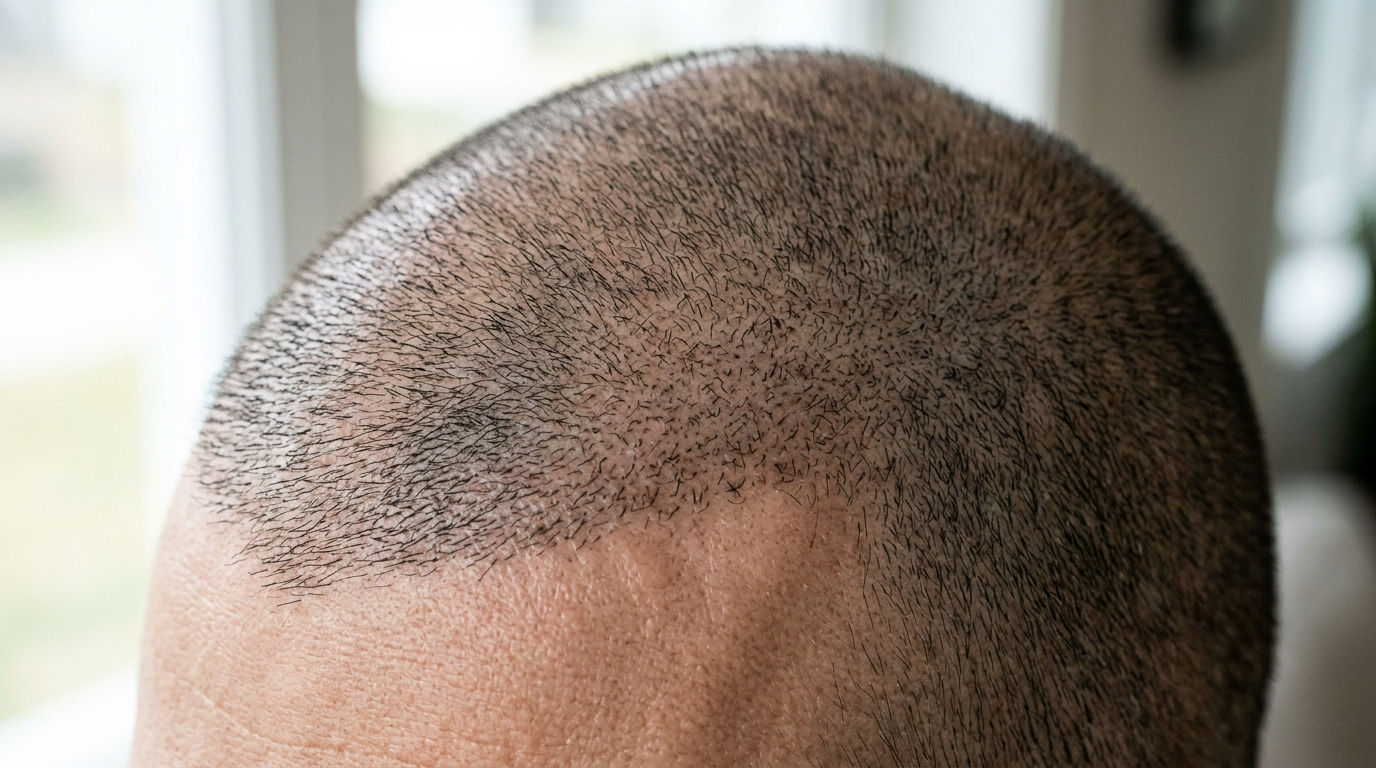
Gender-specific trials show the same distinct separation between active therapy and placebo controls. In a randomized, double-blind trial evaluating at-home 655 nm phototherapy in women with pattern hair loss, Raymond Lanzafame and his team documented a 48.07% average increase in hair count from baseline, representing a 37% net active advantage over the 11.02% change seen in the sham group and adding over 100 hairs in target thinning zones.
His earlier male trial, published in Lasers in Surgery and Medicine, demonstrated terminal hair count gains exceeding 35% over baseline in men with androgenetic alopecia. The sham device produced minimal baseline variance and no significant terminal growth. These figures prove that the follicles are not just surviving; they are physically widening and producing thicker individual hairs.
What to Expect During a Six-Month LLLT Usage Schedule
The biggest hurdle with laser caps is human psychology. Most people abandon treatment right before it starts working because they do not understand the underlying biology. Follicles move at a glacial pace, and you need to know what is happening under your scalp month by month.
Weeks 1 to 6: The Shedding Phase
During the first month and a half, you will likely see an increase in daily shedding. This causes instant panic for most buyers, who assume the device is burning their hair off.
It is actually the clearest indicator that the therapy is working. When laser energy floods the follicular mitochondria with ATP, dormant follicles suddenly wake up and eject their thin, telogen club hairs to make physical room for thicker anagen shafts. You are dropping weak, miniaturized hairs to make physical room for thicker terminal shafts.
Months 2 to 4: The Stabilization Window
By the end of month three, shedding slows dramatically. Your daily hair fall in the shower or brush should drop below your pre-treatment baseline.
The hair will not look radically thicker on camera yet, but the individual roots often feel slightly stiffer and more anchored when you run your hands through your hair. The degenerative cycle of miniaturization has been arrested.
Months 5 to 8: Visible Regrowth
This is the window where patience pays off. Fine, newly recruited hairs begin pushing through the scalp along your parting lines, the vertex crown, and the temporal boundaries.
Because the hair shafts have gained diameter, your overall scalp coverage looks denser. Parts appear tighter, and light no longer shines through your crown under direct bathroom lighting.
Months 9 to 12 and Beyond: Peak Density and Maintenance
Maximum visual gains land between the ninth and twelfth months of treatment. At this point, your hair follicles have cycled through at least one full recovery phase.
Once you achieve peak density, you do not throw the cap in a cupboard. Hair loss is a progressive, chronic condition driven by genetics and hormones. To preserve your gains, you transition to a long-term maintenance schedule, dropping from every other day down to two or three sessions per week.
The most destructive mistake I watch people make with laser hair growth caps is assuming that more is better. Users get impatient, decide that 20 minutes every other day is too slow, and begin wearing the cap for an hour every single night.
When you do that, you run headfirst into a fundamental rule of photobiology called the biphasic dose response curve, or the Arndt-Schulz law. In light therapy, low doses stimulate cellular function, while excessively high doses inhibit it. If you blast the scalp with photons every day, you overdose the tissue. The follicular mitochondria suffer cellular fatigue, the ATP cascade shuts down, and your hair growth stalls out or reverses. Stick to the clinical schedule of 15 to 30 minutes every other day.
Safety Profiles, Side Effects and Treatment Contraindications
Oral medications like Finasteride and Dutasteride can suppress 5-alpha reductase effectively. But altering systemic dihydrotestosterone levels carries potential risks including sexual dysfunction, mood changes, hormonal disruption, or elevated liver enzymes. Low-level lasers bypass these risks completely. Because light energy operates locally, it never enters your bloodstream, alters your hormones, or stresses your liver.

True medical LLLT caps run cold. They emit no ultraviolet wavelengths, generate zero ionizing radiation, and cannot heat or burn scalp tissue. However, clinical honesty demands being clear about who should skip buying one:
- Completely smooth, fibrotic scalps: If a patch of your head has been completely bald for a decade and shines under a lamp, the follicles are dead, scarred over, and gone.
- Advanced hair loss stages: These devices are engineered for early-to-moderate thinning, working best for women classified as Ludwig Grades I to II and men on the Norwood-Hamilton Scale at Stages II through V.
- Inconsistent users: If you cannot commit to wearing a helmet every other day for six to twelve consecutive months, skipping sessions will drop your response rate dramatically.
Maximizing Outcomes with a Multi-Modal Regimen
Low-level laser therapy is a mechanical and energetic intervention. It tackles the energy deficit of thinning hair, but androgenetic alopecia is a multifaceted disease caused by genetics, microcirculation issues, and surface hormonal attacks.
If you rely on a single mechanism, you are leaving hair density on the table. Top hair loss clinics rarely prescribe LLLT as a solo therapy. They use a multi-modal stack to hit follicle wear from every physiological angle. Lasers handle the cellular power supply, driving ATP synthesis and boosting blood flow directly into the skin papilla from within.
At the same time, you need to defend the follicle surface from dihydrotestosterone. DHT binds to androgen receptors in genetically susceptible hair roots, strangling their blood supply and initiating miniaturization. Adding topical natural DHT inhibitors like saw palmetto and rosemary oil helps block androgen binding at the scalp level without causing the hormonal crashes associated with systemic oral drugs.
Finally, pairing light therapy with topical caffeine and biotin serums yields compounding benefits, provided you space them out correctly. Always wear your laser cap on a completely clean, dry scalp before applying any oils or topicals. Heavy serums scatter the beams.
A device like the Livdor Pro uses 272 medical-grade laser diodes operating at a 650 nm wavelength to provide broad, even scalp coverage across the top and crown. The device carries FDA clearance and CE certification, verifying that the diodes produce therapeutic energy rather than ordinary illumination. That matters because power output dictates results.
If you are dealing with early-stage crown thinning or widening part lines and have the discipline to stick to an alternate-day schedule for six months, an authentic medical-grade laser cap is one of the safest, most clinically validated investments you can make for your hair. If you want an overnight miracle without lifting a finger, save your money.
My Personal Advice
Laser caps occupy a distinct middle ground between passive shampoos and prescription hormone blockers. When your follicles are still viable, treating laser therapy as a long-term routine rather than a quick test makes all the difference between frustration and real recovery.
If purchasing, confirm genuine 650 to 655 nm laser diodes over LEDs, look for CE cetification and FDA approval. Commit to an alternate-day routine, and ride out the initial six-week shedding window until fallout subsides, without over-treating the tissue. Enhance my results using the recommended topicals such as hair recovery serums, shampoo and tonics.
FAQ
How long does a quality laser cap last before the diodes lose power?
Medical-grade laser diodes typically have an operational lifespan of 10,000 to 15,000 hours. Used every other day for 25 minutes, the hardware will easily last over a decade without suffering power wear.
Can I share my laser hair growth cap with a partner or family member?
Yes, provided you clean the inner surface between uses. Wipe the interior gently with an alcohol-free sanitizing wipe to remove natural scalp oils without clouding the protective plastic lenses over the laser diodes.
What happens if I stop using the laser cap after regrowing my hair?
Because androgenetic alopecia is a progressive, lifelong genetic condition, stopping therapy causes the revitalized follicles to gradually lose their cellular energy support. Over several months, follicles slip back into miniaturization, shedding resumes, and hair density slowly returns to where you began.


Leave a comment
This site is protected by hCaptcha and the hCaptcha Privacy Policy and Terms of Service apply.