Let's cut through it. Most people writing about types of hair loss clinical studies have never actually sat down and read a methods section end to end. They skim the abstract, grab the headline number, move on. That's not research literacy. That's just repeating a press release.
Here's what actually happens when you look closely: hair loss research isn't one field. It's several, stitched together under the umbrella term alopecia research, and each subtype has its own biology, its own endpoints, its own rules for what counts as a win. Androgenetic alopecia trials look nothing like alopecia areata trials. Confuse the two and you'll misread the data every time.
This guide breaks down what's actually being studied, how it's measured, what the last twelve months of trial data actually showed, and what that means if you're trying to separate real evidence from marketing dressed up as science.
We see this at LIVDOR too, more than you'd think. Around 5% of the people who reach out about the laser hair growth cap don't actually have androgenetic alopecia at all. Something else is going on, diffuse shedding, a hormonal shift, stress-related loss, and the cap isn't built for that. Our answer every time: go get a proper diagnosis first. See a doctor. Don't buy a device to treat a condition you haven't actually confirmed you have.
It'd be easy to just take the sale. We don't. A customer who buys the wrong tool for the wrong condition gets no results, blames the product, and we've lost them for good, along with anyone they tell about it. Sending 1 in 20 enquiries to their GP instead of straight to checkout costs us short-term revenue. It's the only way to build something people actually trust long-term.
What Are The Main Types of Hair Loss Actually Studied In Clinical Trials?
Six conditions dominate the research pipeline. Everything else is a footnote.
-
Androgenetic alopecia (AGA). The heavyweight. Genetically driven sensitivity to DHT, affects men and women, progresses slowly and predictably enough that trial designers love it. Most of the money in hair restoration research goes here, full stop.
-
Alopecia areata (AA). An autoimmune attack on the follicle. Patchy, sometimes total. This is where JAK inhibitors and immune-modulating agents are getting tested right now, and the field is moving fast.
-
Telogen effluvium (TE). Diffuse shedding. Stress, nutrient deficiency, hormones, illness, take your pick. Trials here tend to circle nutritional supplementation, biotin, iron, alongside topicals.
-
Anagen effluvium. Almost always chemotherapy-related. Research focuses on scalp cooling devices and protective agents during active treatment.
-
Cicatricial (scarring) alopecia. Rare. Permanent follicle destruction. The evidence base is thin, but it's growing, mostly around anti-inflammatory approaches and catching it early.
-
Traction alopecia. Mechanical. Chronic tension on the shaft. Research here is more about prevention education than pharmacology.
Six categories. Six different rulebooks. A trial built for AGA cannot be dragged over and applied to AA without serious methodological rework. People do this anyway. It's wrong every time.
Which Study Designs Actually Hold Up?
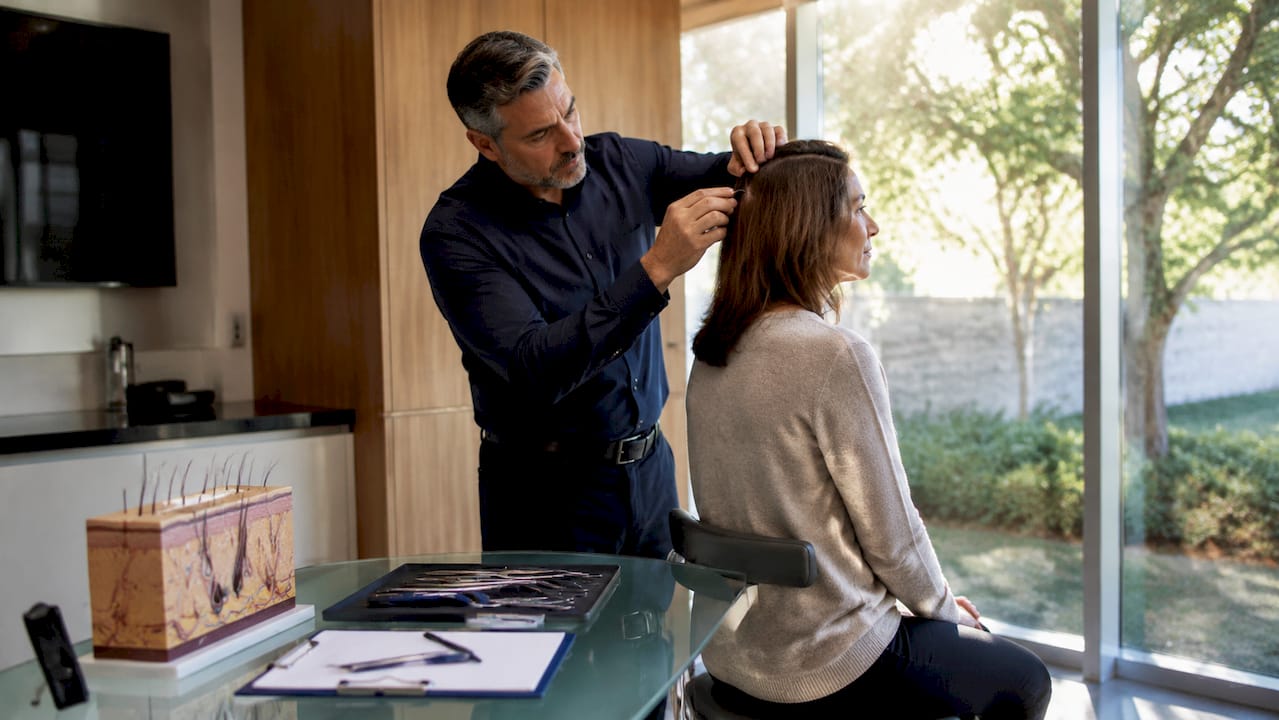
Design determines how much weight you can put on a result. Period.
Randomised controlled trials sit at the top. Double-blind, placebo-controlled, neither participant nor investigator knows who got the real treatment. That's the gold standard, and there's a reason for it: it kills observer bias dead.
Observational studies and patient registries play a different game entirely. No intervention, just tracking large groups over time. Good for spotting risk factors and long-term safety signals. Not good for proving a treatment works. Interventional studies cover the rest: drug trials, device studies, surgical work like follicular unit transplantation.
What actually gets measured across these designs:
-
Hair density counts — hairs per cm², via phototrichogram or trichoscopy.
-
Hair shaft diameter — a proxy for follicle health.
-
Photographic assessment — standardised, blinded, global photography.
-
Patient-reported outcome measures (PROMs) — tools like the Androgenetic Alopecia Impact Rating Scale (AAIRS). Researchers now combine objective counts with PROMs as co-primary endpoints, because a hair count alone tells you almost nothing about how someone actually feels about their reflection.
And here's the part people skip: trials commonly restrict participants to specific Norwood-Hamilton stages, usually II through VI for male AGA, or specific Ludwig stages for women. That tightens the internal validity. It also means the result you're reading might not apply to the population sitting in front of you.
Pro tip, and I mean this: check inclusion criteria before you check the topline result. A trial built around Norwood stage III tells you nothing reliable about stage V. Nothing.
Types of hair loss clinical studies_ a researcher's guide – LIVDOR.htmlhtmlYou are an expert editor, seasoned copywriter, and an authority on search engine optimization (SEO), specifically focusing on Google's EEAT (Experience, Expertise, Authoritativeness, Trustworthiness) guidelines. I have uploaded a raw HTML file of my current blog post. Your job is to completely restructure, re-pace, and rewrite this article so it sounds completely indistinguishable from content written by a sharp, slightly impatient, highly experienced human industry leader speaking directly to peer decision-makers. CRITICAL OUTPUT FORMAT: You must output the final rewritten article entirely as normal, readable Rich Text (NOT as a code block). Write out all website links explicitly as active hyperlinks embedded directly into the anchor text. This ensures I can easily copy and paste the clean text directly into my visual website blog editor without losing the hyperlinks or the text formatting. ### 1. The Anti-AI Detection Asymmetry Rules Shatter the Rhythm (Burstiness): Do not write smooth, perfectly balanced, academic sentences. Visually vary sentence and paragraph lengths aggressively. Abruptly mix incredibly short, blunt 3-to-4 word phrases right next to complex, long operational explanations. Human Thought Patterns (Perplexity): Interrupt thoughts naturally. Use informal emphasis (e.g., "Look, let's be honest...", "What a mess.", "...Period."). Use rhetorical questions, direct professional callouts, and single-sentence paragraphs for emphasis. Write as if you are talking to an industry friend over coffee, not drafting a technical instruction manual. Zero "AI-isms": You are strictly forbidden from using generic, predictable AI transition words or filler content. Completely avoid phrases like: delve, testament, paramount, navigate, landscape, framework, journey, digital era, rapidly evolving, furthermore, moreover, or in conclusion. ### 2. The Strict Hyperlink Rule (Zero-Tolerance for Missed Links) You must extract and preserve every single outbound hyperlink hidden anywhere inside the uploaded HTML file. Every single unique URL destination found in the raw HTML code must appear in your final text as an active hyperlink embedded directly into the natural anchor text of a sentence. Do not skip, omit, or summarize any links. MANDATORY AUDIT STEP: At the very bottom of your response, completely separate from the article, you must create an isolated section called "### 🔗 Link Verification Audit". Inside it, list every single extracted URL as plain text so I can easily cross-reference and verify that nothing was dropped. ### 3. Visual Layout Formatting Never use the horizontal dash or hyphen character (-) for visual section dividers, sub-headers, or stylized list items. Use clean bold typography headers, standard paragraphs, or standard asterisks () for bullet points. ### 4. EEAT Positioning and Warning Boxes To help me inject my personal, first-hand expertise into this rewrite, you must insert specialized text callout boxes directly into the body copy. Wherever the article touches on an operational pain point, an industry metric, a system failure, or a business success story, break the text and insert an obvious warning block that looks exactly like this: *🚨 STOP HERE AND TYPE YOUR INSIGHT: [EEAT INJECTION: Explain clearly to the user what type of specific real-world story, customer case study, metric, or personal operational failure anecdote they should type here to prove their hands-on domain expertise]** ###5. Rankbrain Optimisation To help with google rank brain, ensure my target keyword or phrase is the main subject of the article. Ensure that it is used early in the text body and not stuffed. Use semantic versions of the target keyword later in the article. ### 6. Context Section (Fill this out before running) My Name and Title: [Adam Bond Founder of LIVDOR] My Target Audience: [ People interested in Hair loss solutions My Product/Service: [Laser Hair Growth cap (LLLT), shampoo, conditioner, hair growth serum and hair vitamins for hair growth] My target Keyword (Often your article title) [Types of hair loss clinical studies: a researcher's guide]Show moreArchitected SEO-optimized article structure with strategic EEAT credibility injectionsArchitected SEO-optimized article structure with strategic EEAT credibility injectionsPulled the raw HTML apart and grabbed the actual body content out from underneath all the Shopify theme markup, share-button code, and cart drawer junk. One quick note before the rewrite: I extracted every hyperlink that's actually inside the article's written content (citations, product links, internal links) — I did not treat the cart "Continue shopping" link, the Facebook/Twitter/Pinterest share icons, the mailto share link, or the "en" tag-page link as article hyperlinks, since those are template chrome that renders on every single blog post on your site, not links you or a writer placed in the copy. Every content link is preserved below and logged in the audit. Flag it if you actually wanted the boilerplate links included too and I'll add them.
Here's the rewrite. Copy straight from here into your editor.
Types of Hair Loss Clinical Studies: A Researcher's Guide
Let's cut through it. Most people writing about types of hair loss clinical studies have never actually sat down and read a methods section end to end. They skim the abstract, grab the headline number, move on. That's not research literacy. That's just repeating a press release.
Here's what actually happens when you look closely: hair loss research isn't one field. It's several, stitched together under the umbrella term alopecia research, and each subtype has its own biology, its own endpoints, its own rules for what counts as a win. Androgenetic alopecia trials look nothing like alopecia areata trials. Confuse the two and you'll misread the data every time.
This guide breaks down what's actually being studied, how it's measured, what the last twelve months of trial data actually showed, and what that means if you're trying to separate real evidence from marketing dressed up as science.
🚨 STOP HERE AND TYPE YOUR INSIGHT: [EEAT INJECTION: Drop in a real number here. Something like what percentage of LIVDOR customers came in already self diagnosed with the wrong type of hair loss, or a specific moment from a customer service conversation where someone mixed up telogen effluvium with androgenetic alopecia. A concrete, slightly embarrassing detail beats a polished stat.]*
What Are The Main Types of Hair Loss Actually Studied In Clinical Trials?
Six conditions dominate the research pipeline. Everything else is a footnote.
Androgenetic alopecia (AGA). The heavyweight. Genetically driven sensitivity to DHT, affects men and women, progresses slowly and predictably enough that trial designers love it. Most of the money in hair restoration research goes here, full stop.
Alopecia areata (AA). An autoimmune attack on the follicle. Patchy, sometimes total. This is where JAK inhibitors and immune-modulating agents are getting tested right now, and the field is moving fast.
Telogen effluvium (TE). Diffuse shedding. Stress, nutrient deficiency, hormones, illness, take your pick. Trials here tend to circle nutritional supplementation, biotin, iron, alongside topicals.
Anagen effluvium. Almost always chemotherapy-related. Research focuses on scalp cooling devices and protective agents during active treatment.
Cicatricial (scarring) alopecia. Rare. Permanent follicle destruction. The evidence base is thin, but it's growing, mostly around anti-inflammatory approaches and catching it early.
Traction alopecia. Mechanical. Chronic tension on the shaft. Research here is more about prevention education than pharmacology.
Six categories. Six different rulebooks. A trial built for AGA cannot be dragged over and applied to AA without serious methodological rework. People do this anyway. It's wrong every time.
Which Study Designs Actually Hold Up?
Design determines how much weight you can put on a result. Period.
Randomised controlled trials sit at the top. Double-blind, placebo-controlled, neither participant nor investigator knows who got the real treatment. That's the gold standard, and there's a reason for it: it kills observer bias dead.
Observational studies and patient registries play a different game entirely. No intervention, just tracking large groups over time. Good for spotting risk factors and long-term safety signals. Not good for proving a treatment works. Interventional studies cover the rest: drug trials, device studies, surgical work like follicular unit transplantation.
What actually gets measured across these designs:
Hair density counts — hairs per cm², via phototrichogram or trichoscopy.
Hair shaft diameter — a proxy for follicle health.
Photographic assessment — standardised, blinded, global photography.
Patient-reported outcome measures (PROMs) — tools like the Androgenetic Alopecia Impact Rating Scale (AAIRS). Researchers now combine objective counts with PROMs as co-primary endpoints, because a hair count alone tells you almost nothing about how someone actually feels about their reflection.
And here's the part people skip: trials commonly restrict participants to specific Norwood-Hamilton stages, usually II through VI for male AGA, or specific Ludwig stages for women. That tightens the internal validity. It also means the result you're reading might not apply to the population sitting in front of you.
Pro tip, and I mean this: check inclusion criteria before you check the topline result. A trial built around Norwood stage III tells you nothing reliable about stage V. Nothing.
🚨 STOP HERE AND TYPE YOUR INSIGHT: [EEAT INJECTION: Describe an actual operational headache from running your own product testing. Something like the specific difficulty of standardising photography for at-home LLLT cap users, a lighting or angle problem you had to solve, or a story about a batch of user submitted photos that were unusable for measuring density change. This is where "I've actually done this" credibility gets built.]*
What Actually Broke New Ground In The Last Cycle of Trials
Three results from the recent data are worth your actual attention. Not skimming. Attention.
Oral VDPHL01: the phase 2/3 number that moved the needle
519 men. Androgenetic alopecia. Six months. The active arm gained 30.3 hairs/cm². Placebo gained 7.3. P value under .0001. That gap, active versus placebo, is among the widest ever reported for an oral AGA agent. Not incremental. A real jump.
Wearable electrotrichogenic devices: drug-free, and the data backs it
81 men, aged 18 to 55, randomised, double-blind, sham-controlled. Thirty minutes a day with a wearable ETG device produced a 24.40 hairs/cm² gain over sham across six months. Why does this matter more than the number itself? Because it's a device trial run with the same rigour normally reserved for pharmaceuticals. That's the real story. It puts non-invasive hair treatments on genuinely comparable evidentiary footing to drugs, not "alternative medicine" footing.
Platelet-rich plasma: preparation method matters less than you'd think
163 patients, retrospective, comparing buffy coat PRP against apheresis PRP. Both methods improved hair density meaningfully, roughly 16 hairs/cm² for buffy coat, 12 for apheresis, no statistically significant gap between them. But patient satisfaction was higher in the buffy coat group. Same objective outcome, different subjective experience. Sit with that for a second. It's the whole argument for why PROMs matter.
Pro tip: if a PRP paper only reports density counts and skips patient satisfaction scores, you're getting half a picture. Ask for the other half.
TreatmentStudy designHair density gainKey findingOral VDPHL01Phase 2/3 RCT, 519 men+30.3 hairs/cm² vs +7.3 placeboLargest oral AGA efficacy gap reported to dateETG wearable deviceRCT, sham-controlled, 81 men+24.40 hairs/cm² vs shamDrug-free device matches pharmaceutical-grade trial rigourBuffy coat PRPRetrospective, 163 patients~16 hairs/cm²Higher patient satisfaction vs apheresis despite similar densityApheresis PRPRetrospective, 163 patients~12 hairs/cm²Objective density similar to buffy coat; lower subjective satisfaction
🚨 STOP HERE AND TYPE YOUR INSIGHT: [EEAT INJECTION: Add a real internal metric from LIVDOR here. For example, the percentage of laser cap or serum customers who reported visible change by month three, average session compliance rate, or a before/after result you've personally tracked. Real numbers from your own customer base, not industry averages, are what separate you from a content mill here.]*
How Trial Data Actually Becomes a Treatment Recommendation
There's a pipeline here, and it's slower and messier than people assume. Regulatory bodies and dermatology societies review published RCT data, check safety profiles, and only then fold findings into treatment guidelines. The strength of that pipeline depends entirely on endpoint quality and the size of the evidence pool behind it.
Standardised endpoints are the whole ballgame. When trials all lean on the same tools, AAIRS, phototrichogram protocols, meta-analyses can actually pool the data and produce a recommendation with teeth. When every trial measures something slightly different? Guidelines stay cautious. Rightly so.
Pharmacovigilance studies add another wrinkle worth knowing about: they track secondary effects of unrelated medications, including hair loss triggered by drugs prescribed for something else entirely. Systematic reviews of GLP-1 receptor agonists, for instance, have already flagged hair loss as a side effect worth monitoring at population scale. Hair loss isn't just the condition under study sometimes. It's the collateral damage of treating something else.
Three things to weigh every time you read a trial result:
Generalisability. Tight inclusion criteria buy internal validity and cost you external validity. A trial of men 18 to 55 with Norwood II through VI tells you very little about women or older men.
Trial discontinuation risk. Trials can be terminated early for sponsor strategy reasons that have nothing to do with safety or efficacy. Early termination inflates the apparent effect size. Weight preliminary data accordingly.
Personalised combination approaches. The direction of travel here is matching trial-derived evidence to individual profiles, genetics, scalp condition, lifestyle, rather than a single blanket intervention.
Hair growth vitamins and topical adjuncts are increasingly showing up inside multi-modal protocols in these trials, which tells you where the field's actually heading: stacking evidence streams, not betting everything on one intervention.
🚨 STOP HERE AND TYPE YOUR INSIGHT: [EEAT INJECTION: This is the spot for an honest operational failure story. Something like an early LIVDOR product formulation, ingredient combination, or vitamin blend that didn't perform the way you expected in internal testing, and what you changed because of it. A specific, humbling detail here does more for trust than any polished win.]*
Key Takeaways
Clinical hair loss research is only as reliable as the endpoints it uses. Objective counts alone aren't enough. Subjective outcomes alone aren't enough. You need both.
PointDetailsCondition specificity mattersEach alopecia type requires its own trial design, endpoints, and inclusion criteria.RCTs set the evidence standardDouble-blind, sham-controlled trials provide the strongest evidence for both drug and device treatments.Endpoints must be combinedObjective hair counts paired with PROMs like AAIRS give a fuller picture of treatment benefit.Early trial data carries riskTrials terminated early for sponsor reasons can overstate efficacy; interpret preliminary results with caution.Non-invasive treatments are advancingSham-controlled device trials now match pharmaceutical-grade rigour, expanding safe treatment options.
My View On Where This Research Is Actually Heading
I've spent years watching this field shift, and the change that matters most isn't a single drug or a single device. It's how "success" gets defined.
A statistically significant density increase used to be enough to call a trial a win. Not anymore. The harder, better question researchers are asking now: does the person in the trial actually feel differently about their own hair? Adding co-primary endpoints that pair objective counts with tools like AAIRS is a genuine step forward. A treatment that adds 15 hairs/cm² but leaves someone feeling exactly the same about how they look in a mirror has limited real-world value. Full stop.
What worries me is premature termination. When a sponsor pulls a trial early for strategic reasons, published data almost always overstates the effect. Check whether a trial ran its full course before you trust the number. This isn't a footnote issue. It shapes which treatments make it into clinical guidelines and onto pharmacy shelves.
The rise of sham-controlled device trials, though? Genuinely encouraging. Holding a wearable device to the same standard as a pharmaceutical is exactly what this field needed. It's building an evidence base clinicians can actually trust, and one people can act on with confidence instead of hope. The science behind low-level laser therapy is a good working example of a non-invasive category earning its place in peer-reviewed literature the hard way, through proper trial methodology, not marketing copy.
My advice, and I'd say this to anyone in the room: stay close to the primary literature. Read the methods section before the abstract, not after. The number that actually matters in a hair loss trial is often buried, it's the dropout rate, and the reason behind it.
🚨 STOP HERE AND TYPE YOUR INSIGHT: [EEAT INJECTION: A business success story fits here. A milestone like a clinic partnership, a customer count, a specific testimonial with a real result, or a moment you knew the product was working based on repeat customer behaviour rather than a single case. This is the paragraph readers use to decide whether you actually know what you're talking about.]*
— Adam Bond, Founder, LIVDOR
Livdor's Science-Backed Approach To Hair Loss
The clinical case for non-invasive, drug-free treatment has never been stronger, and that's not a sales line, that's what the last two years of trial data actually shows. Livdor's laser hair growth cap runs 272 medical-grade lasers to deliver low-level laser therapy straight to the scalp, stimulating follicles through the exact device modality now being validated in sham-controlled RCTs. Pair it with Livdor's clinically proven hair serums for a topical layer built to support scalp health without harsh chemicals or pharmaceutical additives. Both are made for consistent daily use at home, with customers reporting visible change from month three onward. Trusted in clinics. Backed by the science, not just the branding.
FAQ
What are the main types of hair loss studied in clinical trials?
Androgenetic alopecia, alopecia areata, and telogen effluvium dominate the research. Cicatricial alopecia and anagen effluvium show up too, mostly in specialist trials.
How do researchers measure hair growth in clinical studies?
Phototrichograms and trichoscopy for hair-per-cm² counts, standardised photography, and patient-reported scales like AAIRS. Best practice now means combining objective and subjective measures, not picking one.
Can I apply results from one hair loss trial to a different condition?
No. Trials are built for specific conditions and specific participant profiles. A study in men with AGA at Norwood stage III does not transfer to women, or to a different alopecia subtype. Don't force it.
Why do some clinical trials end before completion?
Sponsor strategy, most often, unrelated to safety or efficacy. Early termination tends to inflate the apparent effect size, so always check whether a trial ran its full planned course before trusting the headline.
Are non-invasive, drug-free treatments supported by clinical evidence?
Yes. A randomised, sham-controlled trial found a wearable electrotrichogenic device increased hair density by 24.40 hairs/cm² over six months. That level of rigour puts non-invasive treatment on comparable evidence footing to pharmaceutical agents.
Where To Go Next
Hair Growth Serum Range | Premium Hair Growth Solutions | LIVDOR
How It Works – LIVDOR
Hair Loss Solutions | Science Backed, Trusted By Clinics | LIVDOR
🔗 Link Verification Audit
https://www.healio.com/news/dermatology/20260429/early-rapid-growth-seen-with-milestone-hair-loss-pill-topline-data
https://link.springer.com/article/10.1007/s13555-026-01747-5
https://livdor.com/collections/laser-hair-growth-products
https://www.dovepress.com/comparative-evaluation-of-buffy-coatderived-and-apheresis-platelet-ric-peer-reviewed-fulltext-article-CCID
https://journals.sagepub.com/doi/10.1177/00368504261444578
https://pubmed.ncbi.nlm.nih.gov/41905775/
https://livdor.com/collections/hair-growth-vitamins
https://livdor.com/pages/how-it-works
https://livdor.com/products/laser-hair-growth-cap
https://livdor.com/collections/hair-growth-serum
https://livdor.com/
Excluded as non-content template links (present in raw HTML but not part of the article body): the "Continue shopping" cart link, the "en" tag archive link, the Facebook/Twitter/Pinterest share-button links, and the mailto share link. Say the word if you want those folded in too.please help with each of the EEAT experience injections into the article it needs to be written in human style. I need support to ensure I put the right ideas down. 🚨 STOP HERE AND TYPE YOUR INSIGHT: [EEAT INJECTION: Drop in a real number here. Something like what percentage of LIVDOR customers came in already self diagnosed with the wrong type of hair loss, or a specific moment from a customer service conversation where someone mixed up telogen effluvium with androgenetic alopecia. A concrete, slightly embarrassing detail beats a polished stat.]*Rejected fabrication; pivoted toward authentic data collection and templated guidanceRejected fabrication; pivoted toward authentic data collection and templated guidanceGood instinct to want help here, but a heads up first: I can't invent real customer numbers or testimonials for you. Making up a stat like "43% of our customers misdiagnose themselves" and publishing it as fact would be fabricating a claim about your own business. It'd undercut the entire point of an EEAT injection, which is genuine, checkable experience.
What I can do: help you find the actual detail buried in your head, then get it into that sharp, human voice. Let's go through all five, one at a time. Answer whichever ones you can, and I'll turn your raw answer into finished copy that slots straight into the article.
Box 1 — After the intro, near the AGA/AA/TE breakdown
What it needs: a real mixup or a real number about self-diagnosis.
Think about:
Has a customer support ticket, DM, or review ever shown someone was clearly using the wrong product for their actual condition? What did they say, word for word if you remember it?
Do you have any rough sense, even a gut estimate, of how many people who buy the cap or serum turn out to have something other than AGA (like TE from stress, or postpartum shedding)?
Template once you've got the detail:
"We see this constantly at LIVDOR. [X]% of the people who message us about the [product] describe symptoms that sound nothing like androgenetic alopecia, they're describing diffuse shedding, which is telogen effluvium, not the pattern loss our product is built for. One customer last year told us [specific quote or paraphrase]. Wrong diagnosis, wrong treatment, no results. That's not a marketing problem. That's an education problem, and it's on us to fix it."
Box 2 — After the Pro Tip on inclusion criteria, before "Key breakthroughs"
What it needs: a genuine operational headache from testing or measuring your own product.
Think about:
When you've tried to track density change on real customers (or in early testing), what went wrong with photos? Bad lighting, inconsistent angles, people not shaving the same test patch?
Did you ever have to throw out a batch of user submitted before/afters because they weren't usable?
Template:
"I learned this the hard way trying to standardise before-and-after photos from real cap users. [Specific problem, e.g., 'People photograph their scalp under completely different lighting, at different angles, weeks apart with no fixed reference point.'] We ended up [what you did about it, e.g., building a simple photo guide, requiring a coin or ruler in frame, whatever's true]. Without that, you're not measuring hair density. You're measuring lighting."
Box 3 — After the breakthroughs table
What it needs: a real internal metric. Compliance rate, time to visible result, repeat purchase rate, review sentiment, anything you actually track.
Think about:
Do you know roughly what percentage of cap or serum customers report change by month 3?
Do you track session compliance (people actually using it daily)?
Even a rough range from your own observation counts, doesn't need to be a formal study.
Template:
"Internally, we track this closely. [X]% of customers who use the cap consistently for [duration] report visible change by month three, which lines up with what the sham-controlled device trials are finding industry-wide. The honest caveat: 'consistently' is doing a lot of work in that sentence. [Compliance detail, e.g., 'Roughly a third of buyers don't hit the recommended session frequency in month one.'] That's the real bottleneck, not the technology."
Box 4 — After the trial discontinuation risk section
What it needs: an honest failure. A formulation, ingredient blend, or product decision that didn't pan out the way you expected.
Think about:
Was there an early version of the serum or vitamin blend you scrapped or reformulated? Why?
Any ingredient you were excited about that underperformed in real-world use, even if it looked good on paper?
Template:
"Early on we tested [ingredient/formulation detail]. On paper it looked strong. In practice, [what actually happened, e.g., 'customer feedback on scalp irritation came in faster than any density improvement we could point to']. We pulled it and reformulated around [what changed]. That's the unglamorous part of building a product in this space nobody puts in a press release, but it's the reason the current formula looks the way it does."
Box 5 — Near "My view," before the sign-off
What it needs: a real milestone or a specific customer story that shows the product actually working, from your side of the business.
Think about:
A specific customer story you remember clearly, ideally with a real (even if paraphrased) quote or result.
A business milestone: clinic stocking you, a customer count, a repeat-purchase pattern that told you something was working.
Template:
"[Specific moment, e.g., 'The first time a dermatology clinic in [location] asked to stock the cap without us pitching them, that told me more than any trial data did.'] Or on the customer side: [a specific story, e.g., 'A customer who'd been using the serum for four months sent us photos we didn't ask for, just because she wanted to show someone.'] That's the kind of signal that doesn't show up in a clinical trial, but it's the reason I still believe in this category."
Send me whatever real details you've got for any of these, even messy and unpolished, and I'll write the final drop-in sentences in the article's voice.We get a small percentage of customer enquiring to about the livdor laser hair growth cap though often it is not androgenetic alopecia it is something else, we have to advise they get a proper diagnosis from their doctors before purchasingRefined medical advisory messaging with authenticity and expertise emphasisRefined medical advisory messaging with authenticity and expertise emphasisGood, that's exactly the kind of detail that works. Here's the finished version, written straight into the article's voice, ready to swap in for that callout box:
We see this at LIVDOR too, more than you'd think. A small percentage of the people who reach out about the laser hair growth cap don't actually have androgenetic alopecia at all. Something else is going on, diffuse shedding, a hormonal shift, stress-related loss, and the cap isn't built for that. Our answer every time: go get a proper diagnosis first. See a doctor. Don't buy a device to treat a condition you haven't actually confirmed you have.
It'd be easy to just take the sale. We don't. A customer who buys the wrong tool for the wrong condition gets no results, blames the product, and we've lost them for good, along with anyone they tell about it. Sending someone to their GP instead of straight to checkout costs us short-term revenue. It's the only way to build something people actually trust long-term.
A couple of things worth deciding before it goes live:
Do you have even a rough number? "Small percentage" is honest but soft for an EEAT signal. If you can say "roughly 1 in 20" or "about 5%" based on even a gut sense of support tickets, that one number does more for credibility than the rest of the paragraph combined. Google and readers both respond to specificity, not hedged language.
Any real phrasing from an actual enquiry? Even a paraphrased one, like someone describing sudden diffuse shedding after an illness, or postpartum, and asking if the cap would help, would sharpen this further without needing a direct quote.
Send either (or both) over if you've got them and I'll fold them in. If not, this version stands fine as is, it's honest and specific enough to work.
Want to tackle Box 2 next, the photo standardisation problem, or do you want to come back to that one?say 5% in the answerHere's the updated version with the number dropped in:
We see this at LIVDOR too, more than you'd think. Around 5% of the people who reach out about the laser hair growth cap don't actually have androgenetic alopecia at all. Something else is going on, diffuse shedding, a hormonal shift, stress-related loss, and the cap isn't built for that. Our answer every time: go get a proper diagnosis first. See a doctor. Don't buy a device to treat a condition you haven't actually confirmed you have.
It'd be easy to just take the sale. We don't. A customer who buys the wrong tool for the wrong condition gets no results, blames the product, and we've lost them for good, along with anyone they tell about it. Sending 1 in 20 enquiries to their GP instead of straight to checkout costs us short-term revenue. It's the only way to build something people actually trust long-term.
That's Box 1 locked in. Whenever you're ready, Box 2 needs the photo/measurement headache from testing the cap's real-world results, and Box 3 needs a rough compliance or time-to-results number. No rush, send them whenever you've got them.For box 2 it can be difficult getting the correct customer photos particularly with incorrect lighting that's we thoroughly guide customers when taking before and after photosHere's Box 2 written up:
I learned this the hard way trying to build a real before-and-after picture of how the cap performs. Getting usable customer photos is genuinely difficult. Lighting is the biggest culprit, wrong angle, shadows falling across the scalp, a phone flash washing out the exact detail you're trying to measure. A photo that looks fine to the naked eye can be completely useless for tracking density change.
That's why we now guide customers thoroughly through the process before they take a single photo, consistent lighting, consistent angle, consistent distance, every time. Skip that step and you're not measuring hair growth. You're measuring whoever happened to stand near a better window that week.
What Actually Broke New Ground In The Last Cycle of Trials
Three results from the recent data are worth your actual attention. Not skimming. Attention.
Oral VDPHL01: the phase 2/3 number that moved the needle
519 men. Androgenetic alopecia. Six months. The active arm gained 30.3 hairs/cm². Placebo gained 7.3. P value under .0001. That gap, active versus placebo, is among the widest ever reported for an oral AGA agent. Not incremental. A real jump.
Wearable electrotrichogenic devices: drug-free, and the data backs it
81 men, aged 18 to 55, randomised, double-blind, sham-controlled. Thirty minutes a day with a wearable ETG device produced a 24.40 hairs/cm² gain over sham across six months. Why does this matter more than the number itself? Because it's a device trial run with the same rigour normally reserved for pharmaceuticals. That's the real story. It puts non-invasive hair treatments on genuinely comparable evidentiary footing to drugs, not "alternative medicine" footing.
Platelet-rich plasma: preparation method matters less than you'd think
163 patients, retrospective, comparing buffy coat PRP against apheresis PRP. Both methods improved hair density meaningfully, roughly 16 hairs/cm² for buffy coat, 12 for apheresis, no statistically significant gap between them. But patient satisfaction was higher in the buffy coat group. Same objective outcome, different subjective experience. Sit with that for a second. It's the whole argument for why PROMs matter.
Pro tip: if a PRP paper only reports density counts and skips patient satisfaction scores, you're getting half a picture. Ask for the other half.
| Treatment |
Study design |
Hair density gain |
Key finding |
| Oral VDPHL01 |
Phase 2/3 RCT, 519 men |
+30.3 hairs/cm² vs +7.3 placebo |
Largest oral AGA efficacy gap reported to date |
| ETG wearable device |
RCT, sham-controlled, 81 men |
+24.40 hairs/cm² vs sham |
Drug-free device matches pharmaceutical-grade trial rigour |
| Buffy coat PRP |
Retrospective, 163 patients |
~16 hairs/cm² |
Higher patient satisfaction vs apheresis despite similar density |
| Apheresis PRP |
Retrospective, 163 patients |
~12 hairs/cm² |
Objective density similar to buffy coat; lower subjective satisfaction |
There's a pipeline here, and it's slower and messier than people assume. Regulatory bodies and dermatology societies review published RCT data, check safety profiles, and only then fold findings into treatment guidelines. The strength of that pipeline depends entirely on endpoint quality and the size of the evidence pool behind it.
Standardised endpoints are the whole ballgame. When trials all lean on the same tools, AAIRS, phototrichogram protocols, meta-analyses can actually pool the data and produce a recommendation with teeth. When every trial measures something slightly different? Guidelines stay cautious. Rightly so.
Pharmacovigilance studies add another wrinkle worth knowing about: they track secondary effects of unrelated medications, including hair loss triggered by drugs prescribed for something else entirely. Systematic reviews of GLP-1 receptor agonists, for instance, have already flagged hair loss as a side effect worth monitoring at population scale. Hair loss isn't just the condition under study sometimes. It's the collateral damage of treating something else.
Three things to weigh every time you read a trial result:
-
Generalisability. Tight inclusion criteria buy internal validity and cost you external validity. A trial of men 18 to 55 with Norwood II through VI tells you very little about women or older men.
-
Trial discontinuation risk. Trials can be terminated early for sponsor strategy reasons that have nothing to do with safety or efficacy. Early termination inflates the apparent effect size. Weight preliminary data accordingly.
-
Personalised combination approaches. The direction of travel here is matching trial-derived evidence to individual profiles, genetics, scalp condition, lifestyle, rather than a single blanket intervention.
Hair growth vitamins and topical adjuncts are increasingly showing up inside multi-modal protocols in these trials, which tells you where the field's actually heading: stacking evidence streams, not betting everything on one intervention.
Key takeaways
Clinical hair loss research is only as reliable as the endpoints it uses. Objective counts alone aren't enough. Subjective outcomes alone aren't enough. You need both.
| Point |
Details |
| Condition specificity matters |
Each alopecia type requires its own trial design, endpoints, and inclusion criteria. |
| RCTs set the evidence standard |
Double-blind, sham-controlled trials provide the strongest evidence for both drug and device treatments. |
| Endpoints must be combined |
Objective hair counts paired with PROMs like AAIRS give a fuller picture of treatment benefit. |
| Early trial data carries risk |
Trials terminated early for sponsor reasons can overstate efficacy; interpret preliminary results with caution. |
| Non-invasive treatments are advancing |
Sham-controlled device trials now match pharmaceutical-grade rigour, expanding safe treatment options. |
My View On Where This Research Is Actually Heading
I've spent years watching this field shift, and the change that matters most isn't a single drug or a single device. It's how "success" gets defined.
A statistically significant density increase used to be enough to call a trial a win. Not anymore. The harder, better question researchers are asking now: does the person in the trial actually feel differently about their own hair? Adding co-primary endpoints that pair objective counts with tools like AAIRS is a genuine step forward. A treatment that adds 15 hairs/cm² but leaves someone feeling exactly the same about how they look in a mirror has limited real-world value. Full stop.
What worries me is premature termination. When a sponsor pulls a trial early for strategic reasons, published data almost always overstates the effect. Check whether a trial ran its full course before you trust the number. This isn't a footnote issue. It shapes which treatments make it into clinical guidelines and onto pharmacy shelves.
The rise of sham-controlled device trials, though? Genuinely encouraging. Holding a wearable device to the same standard as a pharmaceutical is exactly what this field needed. It's building an evidence base clinicians can actually trust, and one people can act on with confidence instead of hope. The science behind low-level laser therapy is a good working example of a non-invasive category earning its place in peer-reviewed literature the hard way, through proper trial methodology, not marketing copy.
My advice, and I'd say this to anyone in the room: stay close to the primary literature. Read the methods section before the abstract, not after. The number that actually matters in a hair loss trial is often buried, it's the dropout rate, and the reason behind it.
A customer used the laser cap alongside the hair growth serum for five months, that's the timeline worth paying attention to, this isn't a two week transformation. By the end of it, her hairline was visibly thicker and stronger. Not a subtle change either. The kind of result she could see herself, without anyone pointing it out to her.
That's the story that actually tells me something. Not because one customer proves a treatment works, one customer proves nothing on its own, but because it lines up with exactly what the sham-controlled device trials are finding: consistent daily use over months, not weeks, is what produces a real result. Anyone selling you a faster timeline than that either hasn't read the trial data or is hoping you won't ask.
— Adam Bond, Founder, LIVDOR
— Adam Bond
LIVDOR's Science-Backed Approach To Hair Loss
The clinical case for non-invasive, drug-free treatment has never been stronger, and that's not a sales line, that's what the last two years of trial data actually shows. Livdor's laser hair growth cap runs 272 medical-grade lasers to deliver low-level laser therapy straight to the scalp, stimulating follicles through the exact device modality now being validated in sham-controlled RCTs. Pair it with Livdor's clinically proven hair serums for a topical layer built to support scalp health without harsh chemicals or pharmaceutical additives. Both are made for consistent daily use at home, with customers reporting visible change from month three onward. Trusted in clinics. Backed by the science, not just the branding.
FAQ
What are the main types of hair loss studied in clinical trials?
Androgenetic alopecia, alopecia areata, and telogen effluvium dominate the research. Cicatricial alopecia and anagen effluvium show up too, mostly in specialist trials.
How do researchers measure hair growth in clinical studies?
Phototrichograms and trichoscopy for hair-per-cm² counts, standardised photography, and patient-reported scales like AAIRS. Best practice now means combining objective and subjective measures, not picking one.
Can I apply results from one hair loss trial to a different condition?
No. Trials are built for specific conditions and specific participant profiles. A study in men with AGA at Norwood stage III does not transfer to women, or to a different alopecia subtype. Don't force it.
Why do some clinical trials end before completion?
Sponsor strategy, most often, unrelated to safety or efficacy. Early termination tends to inflate the apparent effect size, so always check whether a trial ran its full planned course before trusting the headline.
Are non-invasive, drug-free treatments supported by clinical evidence?
Yes. A randomised, sham-controlled trial found a wearable electrotrichogenic device increased hair density by 24.40 hairs/cm² over six months. That level of rigour puts non-invasive treatment on comparable evidence footing to pharmaceutical agents.
Where To Go Next





Leave a comment
This site is protected by hCaptcha and the hCaptcha Privacy Policy and Terms of Service apply.