

If the strand has a white bulb at one end, it’s shedding from the root. If it’s frayed or blunt with no bulb, it snapped somewhere along the shaft. Breakage means the hair has fractured under stress, so no bulb appears at all, while genuine shedding releases the whole follicle, bulb included. Pick up a fallen strand now and check both ends; the next section shows you how to confirm what you’re seeing.
TL;DR:
- Most shedding involves hair with a bulb at the root, while breakage results in blunt, frayed ends without a bulb and shorter hair pieces.
- A pull test losing more than five to six hairs indicates active shedding, while less suggests normal hair cycle variation.
- Maneuvering tension, excessive heat, and chemical treatments primarily cause breakage, which can be prevented with proper hair care routines.
- Hair loss from the follicle usually relates to hormonal, genetic, or nutritional factors, and it shows as scalp thinning or receding hairlines.
- Managing both breakage and shedding requires a stepwise approach focused on assessing, stopping damage, and supporting the scalp with consistent routines and professional help if needed.
Breakage vs hair loss: five quick checks you can do today
You do not need a dermatology degree to work out what is happening on your pillow. You need good light, a few fallen strands, and about ten minutes. These five checks, used together, tell you far more than any single glance in the mirror.
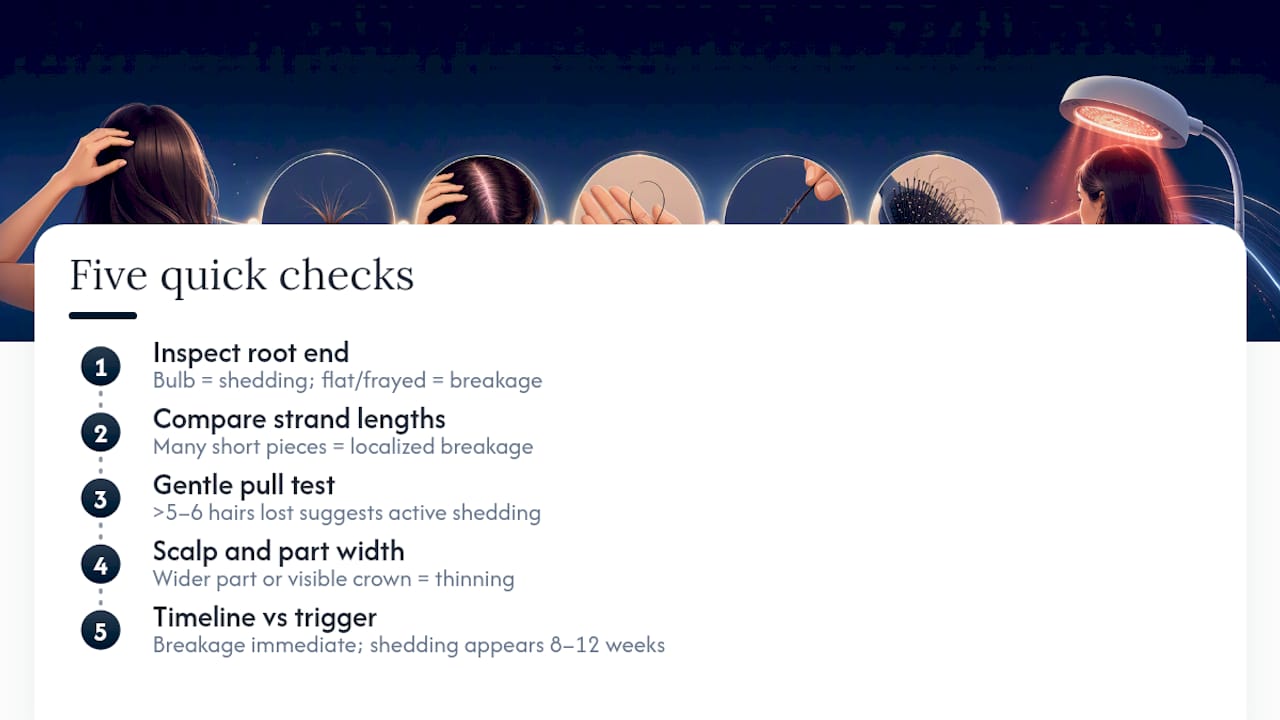
1. Inspect the root end for a bulb. Hold the strand up to a window or lamp and look closely at the end that was attached to your scalp. A small, translucent or slightly darkened bulb means the hair released from the follicle naturally, which points to shedding. A flat, frayed, or paintbrush-like tip with nothing bulbous at all means the shaft snapped, which points to breakage.
2. Compare lengths across several strands. Collect ten to twenty hairs from your brush or shower drain over a day or two. If most match your natural hair length and taper to a bulb, that is shedding. If you find a cluster of noticeably shorter pieces mixed in with your longer hair, that is breakage, and it usually means one section of your head is under more mechanical stress than the rest.
3. Run a gentle pull test. Take a small section of unwashed hair, roughly 60 strands, and pull firmly but gently from root to tip. Losing more than five or six hairs in this single pull suggests active shedding worth monitoring, according to guidance from the American Academy of Dermatology (AAD). Fewer than that, even alongside visible breakage, is generally within a normal range.
4. Look for scalp and part-width clues. Widening at the part, a receding hairline, or visible scalp at the crown all point towards follicle-level thinning rather than shaft damage. Dermatologists interviewed by Men’s Health note that breakage tends to leave uneven lengths and frizz without ever changing how much scalp shows through, whereas genuine hair loss changes the visible geography of your scalp itself.
5. Track the timeline against your habits. Breakage correlates almost immediately with a damaging routine: a fresh bleach job, a tight ponytail worn daily, a new heat-styling habit. Diffuse shedding tied to stress, illness, or a medication change typically shows up 8 to 12 weeks after the trigger, not the next day. That delay is one of the most useful diagnostic clues available to you, because it rules out whatever you were doing last week as the cause.
Pro Tip: Keep a small sandwich bag of fallen strands for a week and sort them into two piles, “bulb” and “no bulb”, as you go. The ratio between the two piles tells you more than any single day’s observation, and it gives a clinician a head start if you do need an appointment.
What causes hair breakage, and how do you stop it?
Breakage is structural damage along the hair shaft, caused almost entirely by external forces rather than what is happening inside your body. The cuticle, the hair’s protective outer layer, wears down until the shaft simply gives way somewhere along its length. Understanding which of these forces applies to you is the fastest route to stopping it.
Heat styling is the most common culprit. Straighteners and curling wands used above 180°C on a regular basis progressively strip moisture from the cuticle, and repeated exposure without a protectant compounds the damage session after session. Chemical processing, including bleach, relaxers, and permanent colour, breaks down the internal protein bonds that give hair its strength, which is why heavily processed hair often feels rougher and snaps more easily under normal handling.
Tension is the quieter cause, and it catches a lot of people out. Tight ponytails, braids pulled taut at the hairline, hair extensions, and even the humble elastic band worn in the same spot every day create a mechanical weak point that eventually fails. Add a dry environment or hair with high porosity, meaning the cuticle lets moisture escape faster than it takes it in, and the shaft becomes even more brittle. Nutrition and certain medical conditions can play a secondary role too, since protein deficiency and some thyroid issues make hair more fragile overall, though Healthline points to mechanical and chemical stress as the dominant drivers in most cases.
Stopping breakage comes down to a short list of changes:
- Use a heat protectant every time you style, and keep tools below 180°C where possible.
- Space out chemical treatments and avoid layering bleach on top of recent colour.
- Loosen ponytails and braids, and move elastic bands to a different section of hair each day.
- Deep-condition weekly with ingredients that rebuild the shaft: keratin for structural strength, panthenol for moisture retention, and ceramides to reinforce the cuticle.
- Trim split ends every 10 to 12 weeks before the split travels further up the strand.
None of this reverses damage that has already happened higher up the shaft, but it stops new breakage forming, and healthy growth from the scalp down eventually replaces what was lost.
What causes hair loss and shedding at the follicle level?
Hair loss originates at the follicle, not the shaft, and internal triggers such as hormones, genetics, nutrition, or stress usually sit behind it. The two patterns worth knowing are telogen effluvium and androgenetic alopecia, because they behave very differently and call for different responses.
Telogen effluvium is diffuse shedding that follows a delay of roughly 8 to 12 weeks after a triggering event: childbirth, a fever, major surgery, a crash diet, or a period of significant stress. It affects hair fairly evenly across the whole scalp rather than in one patch, and the good news is that it is usually temporary once the trigger resolves.
Androgenetic alopecia is a different animal entirely. It follows a genetic and hormonal pattern, showing up as a widening part or receding hairline in a gradual, progressive way over months and years rather than weeks. Losing more than the 50 to 100 hairs a day considered part of a normal cycle, especially if that pattern persists, is when it moves from ordinary shedding into something worth investigating.
A handful of underlying causes are worth ruling out early:
- Thyroid dysfunction, both underactive and overactive, disrupts the hair growth cycle and often shows up alongside fatigue or weight changes.
- Iron deficiency, checked via a ferritin blood test, is one of the most common and most fixable contributors to diffuse shedding.
- Hormonal shifts, including postpartum changes and certain contraceptive changes, frequently trigger a telogen effluvium episode.
- Nutritional gaps, particularly in protein, biotin, and zinc, weaken the follicle’s ability to produce strong new growth.
Shed hairs from genuine hair loss carry a visible bulb at the root and are typically full length, distinguishing them from the short, bulb-less fragments of breakage. Recovery from telogen effluvium is often good once the trigger passes, though it can take several months for density to visibly return; androgenetic alopecia tends to be progressive without intervention, which is why catching it early matters.
When breakage and shedding overlap, which one takes priority?
Plenty of people have both problems running at once, and figuring out which one is doing the most damage changes how you should spend your time and money. Sort your collected strands into the two piles from the earlier check, bulbs on one side, blunt fragments on the other, and the larger pile tells you where to focus first.
If fragments dominate, breakage is your primary issue, even if a background level of normal shedding is also present. If bulbs dominate and you are consistently pulling more than five or six hairs during the pull test, follicle-level thinning deserves the closer look, and breakage becomes the secondary concern to manage alongside it.
Stopping mechanical damage is usually the sensible first move regardless of which one is dominant, because it is the fastest variable to control and it removes noise from your assessment. It also matters for another reason: heavy breakage can mask the early stages of pattern thinning, since a scalp covered in short, damaged regrowth can look thinner than it actually is once that regrowth is protected and allowed to lengthen normally.
A sensible short-term triage looks like this:
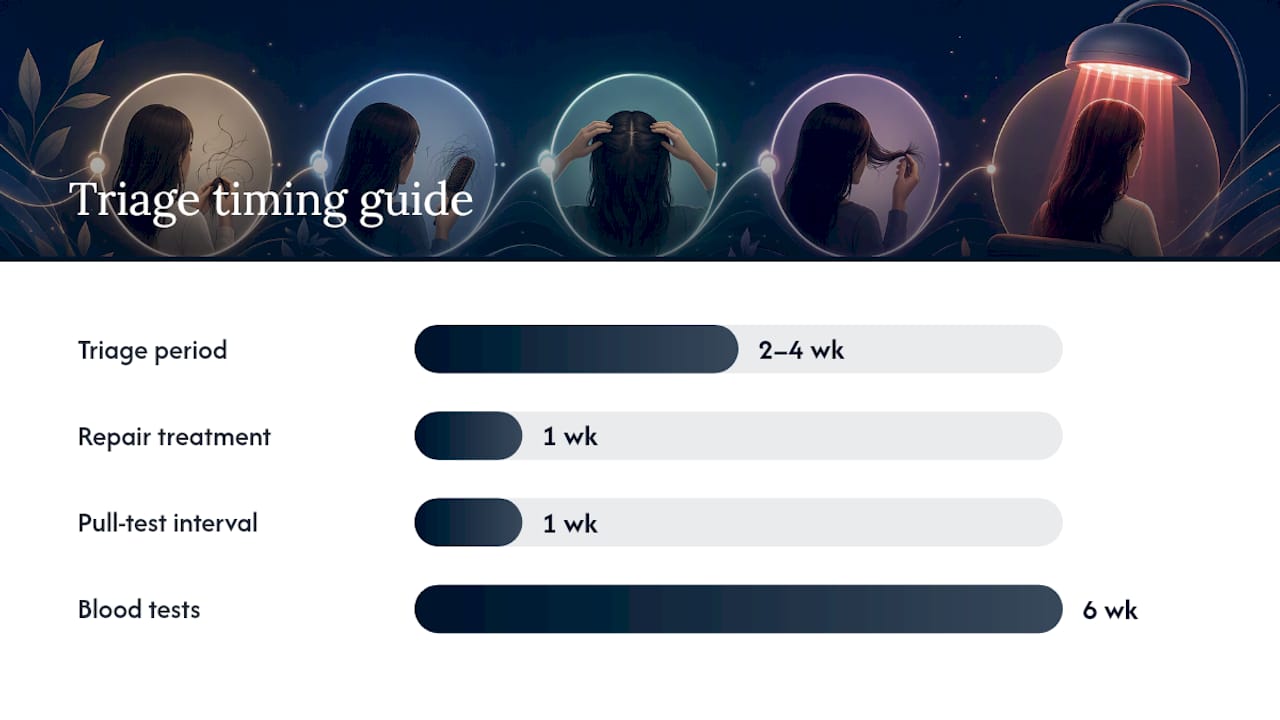
- Stop all avoidable heat, chemical, and tension damage for two to four weeks.
- Switch to gentle, sulphate-free washing and a weekly repair treatment.
- Track shedding with the pull test weekly rather than daily, since day-to-day variation is normal.
- Request basic blood tests, ferritin and thyroid function especially, if shedding persists past six weeks with no obvious trigger.
Building the right routine for breakage, for shedding, or for both
The plan changes depending on which problem you are actually solving, and mixing the wrong tactics wastes time. Here is how to build each one properly.
For breakage, the daily habits matter more than any single product. Protect hair from heat every time, loosen tight styles, and give the shaft a genuine weekly repair session rather than relying on daily rinse-out conditioner alone. Look for ingredients that rebuild strength from the inside: keratin, panthenol, and ceramides all show up repeatedly in reputable repair formulations for good reason. Trim every 10 to 12 weeks, and expect visible improvement in three to four months as damaged growth is cut away and healthier hair takes its place.
For shedding, the timeline runs longer and the expectations need adjusting from the start. If a clinician recommends a topical treatment such as minoxidil, be aware that an early increase in shedding, sometimes called the “dread shed”, is a recognised part of the response in many patients, usually peaking within the first few weeks before settling as follicles cycle into a new growth phase. Stopping treatment at that point is one of the most common mistakes people make, because it happens right when the hair cycle is resetting, not failing.
For both together, a combined approach tends to work best, pairing shaft repair with follicle-level support rather than picking one and ignoring the other. This is where low-level laser therapy, or LLLT, earns its place. LLLT devices, like the 652nm laser cap Livdor supplies, are designed to stimulate circulation and cellular activity at the follicle without drugs or invasive procedures, making them a sensible non-pharmaceutical option to run alongside topical shaft repair. Livdor also produces supportive products such as a rosemary and saw palmetto conditioner, biotin-based shampoos, and a hair growth serum blending biotin, caffeine, and Pro-Vitamin B5, all of which pair naturally with a laser device rather than competing with it.
A practical starter routine looks like this:
- Weeks 1 to 4: stop damaging habits, introduce a gentle shampoo and weekly repair mask, begin LLLT sessions per the device’s recommended schedule.
- Weeks 5 to 8: add a biotin-based serum or gummy for nutritional support, continue tracking with the weekly pull test.
- Weeks 9 to 12: reassess. Breakage should show visible improvement in texture and reduced fragment count; follicle-level changes take longer, and most LLLT users are advised to expect visible density changes from around three months onward rather than sooner.
- Beyond week 12: continue the combined routine, trimming regularly, and revisit a clinician if shedding has not slowed.
Pro Tip: Photograph your part line and hairline from the same angle, in the same light, every four weeks. Memory is unreliable over months, and side-by-side photos catch small changes long before you’d notice them by eye alone.
When should you see a clinician about hair breakage or loss?
Certain signs move this from a home-care question to one that needs a professional opinion. Patchy hair loss, especially in smooth round patches, scalp redness, itching, flaking, or pain, and sudden heavy shedding that seems to accelerate rather than settle all warrant an appointment rather than another few weeks of watching and waiting.
A clinician’s first visit typically follows a predictable pattern:
- A detailed history covering recent illness, medication changes, stress, diet, and family history of hair loss.
- A pull test performed in-clinic under consistent conditions.
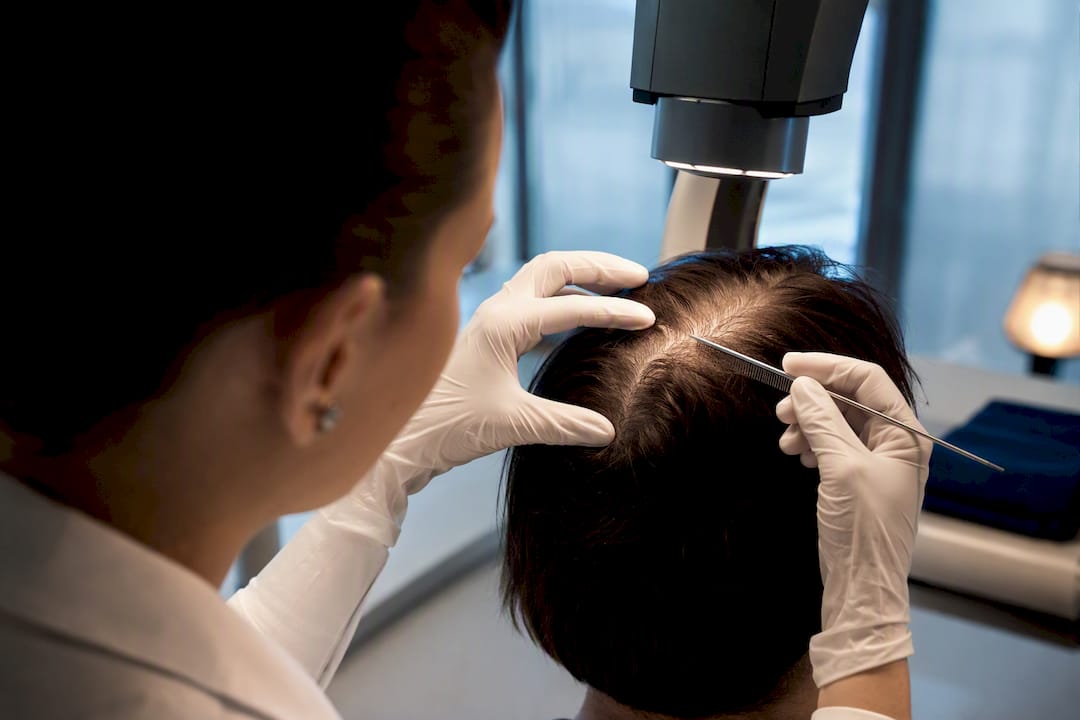
- Trichoscopy, a magnified scalp examination that reveals follicle-level detail invisible to the naked eye.
- Blood tests where indicated, commonly TSH for thyroid function, ferritin or full iron studies, a full blood count, and hormone panels if a hormonal cause is suspected.
These tools let a clinician distinguish a temporary telogen effluvium episode, which typically resolves on its own within months, from a progressive pattern-loss condition that benefits from earlier intervention. To speed up that diagnosis, bring dated photos of your scalp and hairline, a list of any new medications or supplements from the past six months, and notes on any major life events, illness, or stress in the preceding three months. That timeline detail alone often narrows down the likely cause before a single test result comes back.
A sensible, stepwise approach to hair breakage and loss
The mistake I see most often is treatment-hopping: someone notices more hair on the pillow, panics, buys three products in a week, switches all of them within a fortnight because nothing feels like it is “working”, and ends up with no clean way to tell what actually helped.
Assess first. Stop the damage second. Support the scalp third. That order matters, because skipping straight to follicle-targeted treatments while still bleaching hair every six weeks means you are fighting yourself. It also matters in the other direction: if you start a follicle-focused routine and see an early increase in shedding, that is frequently the hair cycle resetting, not the treatment failing, and abandoning it at that exact moment is how people miss out on results that were only a few weeks away.
Where both problems genuinely exist, and plenty of people’s hair tells a mixed story, the strongest outcomes I have seen described come from pairing shaft repair with genuine follicle support, rather than treating one as a substitute for the other.
— Adam Bond
Where LLLT and premium hair care fit into your plan
If your checks point towards early thinning, or a mixed picture of breakage and follicle-level shedding, a laser cap gives you a non-pharmaceutical way to support regrowth without committing to daily topical treatments or prescription routes. Livdor’s laser hair growth products use 650nm wavelength medical-grade lasers designed to work with the hair’s own growth cycle rather than against it, and they suit anyone whose pull test and bulb check suggest follicle involvement alongside everyday damage.

The device works best as part of a combined routine rather than in isolation. Pairing it with a rosemary and saw palmetto conditioner, a biotin and caffeine shampoo, and Livdor’s biotin-rich hair growth serum gives the shaft repair support while the laser cap addresses the follicle, and a daily biotin gummy covers the nutritional side that clinicians so often flag as a contributing factor. Most people using LLLT consistently report starting to notice change from around the three-month mark, so give the routine a fair trial rather than judging it after a fortnight, and if you have any red flags such as scalp symptoms or sudden patchy loss, see a clinician alongside starting the routine rather than instead of it. Browse the laser hair growth cap to see the full specification and start building your combined plan today.
Sources
For deeper clinical detail on shedding thresholds and red flags, the American Academy of Dermatology’s guidance is a solid starting point. For a closer look at how clinical PRP results compare with other follicle-support approaches, see this partner deep dive on PRP therapy. Readers wanting more on non-drug options can also read Livdor’s guide to non-pharmaceutical thinning remedies.
- Shedding — American Academy of Dermatology (AAD)
- The difference between hair thinning and breakage — Men’s Health
- Hair breakage — Healthline
FAQ
How do I know if my hair is breaking or falling out?
Check the root end of a fallen strand: a visible bulb means it fell out naturally, while a frayed or blunt end with no bulb means it snapped from breakage.
Is my hair thinning or just breaking?
Thinning shows up as visible scalp, a widening part, or a receding hairline, while breakage leaves uneven lengths and frizz without changing how much scalp is visible.
Can hair grow back from breakage?
Yes. Breakage does not damage the follicle, so once damaging habits stop and the shaft is protected, new growth replaces the broken hair over three to four months.
Which vitamin deficiency causes hair breakage?
Low protein, biotin, and zinc levels are commonly linked to weaker, more brittle hair, though mechanical and chemical stress remain the dominant causes of breakage overall.


Leave a comment
This site is protected by hCaptcha and the hCaptcha Privacy Policy and Terms of Service apply.