
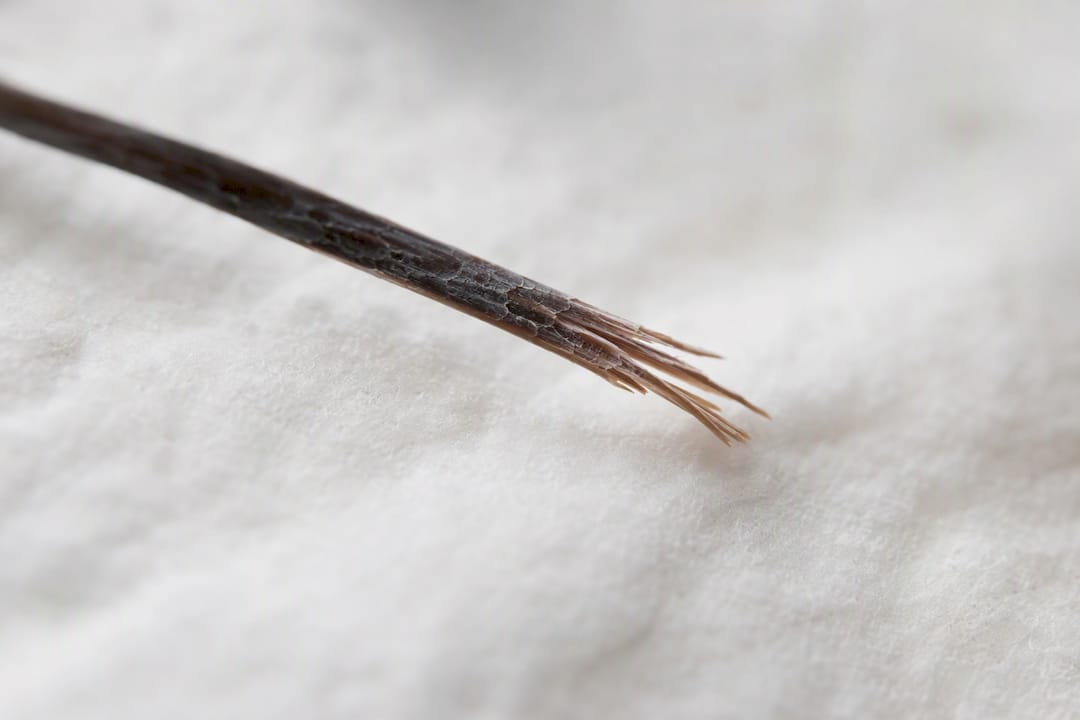
Split ends are the visible result of cumulative mechanical and chemical damage to the hair shaft, not a sign your hair is “unhealthy” overall. The fix is immediate and simple: trim off the damaged tips, stop whatever’s causing the wear, then start protecting what’s left.
Do this in the next 24 to 72 hours:
- Book a trim, even a small one, to remove the frayed sections.
- Cut back on heat styling and drop the temperature on any tool you still use.
- Switch to a gentler detangling routine, especially on wet hair.
- Apply a leave-in conditioner or serum to the mid-lengths and ends.
Key Takeaways
Split ends form when repeated heat, chemical processing and friction wear away the cuticle until cracks propagate into the cortex, and trimming is the only way to remove them completely.
| Point | Details |
|---|---|
| Trim first | Remove existing splits before starting any new routine, since no product reverses them. |
| Fix the biggest habits | Cut back on heat styling, chemical processing and rough handling of wet hair. |
| Identify the pattern | A tree or fork split signals deeper, longer-standing damage than a simple double split. |
| Check nutrition, don’t assume it | Biotin and other supplements help most when an actual deficiency exists; confirm with a clinician first. |
| Address thinning separately | For split ends alongside thinning, pair topical serums and conditioners with an LLLT laser cap for follicle-level support. |
What causes split ends: the basic mechanism
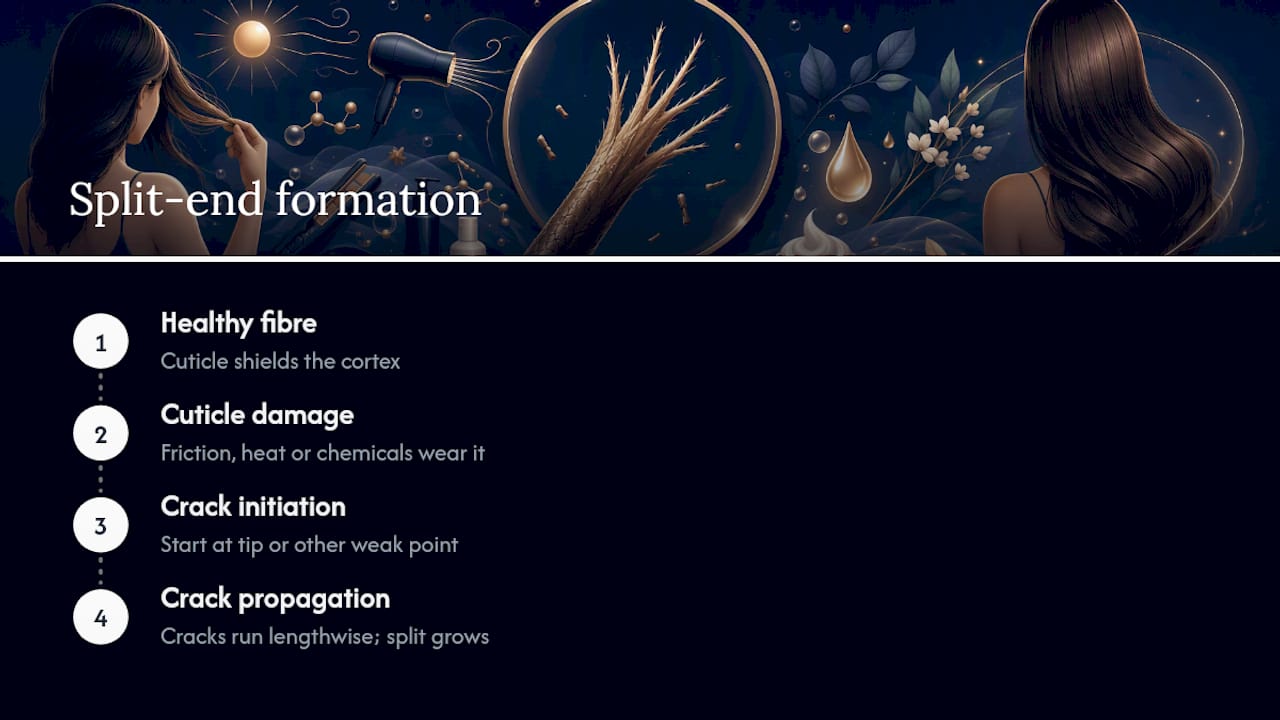
A healthy hair fibre has an outer cuticle layer protecting the cortex underneath. Once friction, heat or chemicals wear that cuticle away, the cortex is exposed and small cracks start to run lengthwise up the shaft.
Hair behaves like a keratin composite. It’s strong when stretched but vulnerable to splitting once its transverse strength, the bonds holding the fibre together sideways, breaks down. Researchers studying the biomechanics of splitting hairs describe this as a genuine fracture-mechanics problem: cracks initiate at a weak point and propagate along the fibre with everyday handling. Picture a labelled cross-section: cuticle on the outside, cortex within, and a crack creeping up from the tip. That image explains why a split rarely stays small.
What are the main causes of split ends?
Most split ends trace back to five everyday habits, and each wears down the hair shaft in a slightly different way.
- Heat styling. Blow-dryers, flat irons and curling wands strip moisture from the cuticle and weaken the internal bonds with repeated exposure, leaving the fibre brittle at the tip, as explained by an expert clinician’s perspective on heat-related hair damage.
- Chemical processing. Bleach, perms, relaxers and frequent colouring oxidise the hair’s internal structure. Bleaching in particular damages cysteine bonds and increases cuticle porosity, which is why bleached hair fails much faster in laboratory fatigue tests.
- Mechanical friction and handling. Brushing wet hair, rubbing it roughly with a towel, tight hairstyles and elastic bands all put stress on the shaft. Wetting hair breaks hydrogen bonds and temporarily weakens tensile strength, so hair is at its most fragile straight out of the shower. Lab tests using moving-loop fatigue rigs, which mimic the way strands tangle and loop during combing, show that knotted sections concentrate stress and split first.
- Environmental and lifestyle factors. UV exposure, chlorine, hard water and general dryness all accelerate cuticle wear over time.
- Product-related causes. Harsh sulphate shampoos, alcohol-heavy styling sprays and overuse of long-hold fixatives strip natural oils and leave ends parched.
Pro Tip: If you only change two things this month, stop brushing wet hair and turn your heat tools down by one setting. Those two habits do more damage than almost anything else on this list, and both cost nothing to fix.
What do different types of split ends look like?
Not every split is the same, and the pattern tells you something about how deep the damage runs.
- Double or Y-split: the classic fork shape, usually surface-level wear from heat or friction.
- Partial split: a small crack that hasn’t travelled far up the shaft yet, often an early warning sign.
- Tree split: multiple branches along one strand, signalling long-standing, repeated damage.
- Fork split: three or more prongs, typically from a combination of chemical and heat stress.
Examine ends in good light after washing. A tree split means the fibre has been compromised for a while and needs trimming rather than a serum fix.
How can I prevent split ends day to day?
Prevention comes down to reducing friction, adding moisture, and being consistent. Here’s a routine that covers wash day through to monthly maintenance.
- Shampoo gently. Use a sulphate-light formula, such as a biotin shampoo with caffeine, and avoid scrubbing the lengths.
- Condition mid-length to ends. Skip the roots and focus conditioner where dryness accumulates.
- Detangle before you wash it out. Start with a wide-tooth comb at the tips and work upward, never the reverse.
- Blot, don’t rub. A soft microfibre towel or old cotton T-shirt causes far less friction than terry cloth.
- Air-dry when you can. If you diffuse or blow-dry, apply a heat protectant first and keep the tool moving.
- Deep condition weekly. A mask restores moisture that daily washing removes.
- Swap elastics for silk. Silk scrunchies reduce the snagging that causes breakage at the point of tension.
- Trim every 8 to 12 weeks. This is the only step that removes existing damage rather than just slowing new damage.
For ongoing support, a rosemary and saw palmetto conditioner helps rebuild the hair’s outer barrier, while a hair growth serum with biotin, caffeine and pro-vitamin B5 nourishes the mid-lengths and ends between washes. If you’re also noticing thinning at the crown or parting, that’s usually a different problem needing a different tool, and it’s worth reading about where LLLT laser caps fit into that picture further down.
Pro Tip: Change habits gradually rather than overhauling your entire routine overnight. Swapping one product a week is far more sustainable than throwing out everything and starting from scratch, and it makes it easier to spot what’s actually working.

Can split ends be repaired, or do they need trimming?
Split ends cannot fuse back together. Once a crack has propagated into the cortex, the fibre stays compromised, and trimming is the only way to remove it completely. Everything else on the market slows the process or disguises it.
That said, some treatments genuinely help in the meantime:
- Bonding and smoothing treatments at a salon can temporarily seal the frayed cuticle, making ends look smoother for a few weeks.
- Serums and sealers coat the fibre and reduce the visible fraying, though the underlying crack is still there.
- Deep conditioning and protein/moisture balancing slow further propagation by keeping the shaft more pliable and less prone to snapping.
Use sealing treatments to buy time between trims, not instead of them. If you’re due a cut, get it, then use a serum to protect the fresh ends going forward.
When should split ends worry you enough to see a professional?
Occasional split ends are normal. A sudden surge across many strands, visible thinning at the root, patchy breakage, or scalp symptoms like itching and inflammation are different matters.
- Book a trichologist or dermatologist if shedding increases noticeably or thinning appears alongside the splitting.
- Bring photos and a timeline of any recent colour, heat or chemical treatments to the appointment.
- While you wait, pause chemical processing, handle hair gently, and keep a simple log of changes.
Does nutrition affect split ends, and do supplements help?
Hair strength depends partly on what you eat. Deficiencies in protein, iron, vitamin D or biotin can leave the shaft more fragile and prone to breaking at stress points, though nutrition alone won’t undo existing splits.
Biotin supplementation tends to help most when there’s an actual deficiency; if your levels are already normal, extra biotin is unlikely to change much. Topical actives like caffeine and pro-vitamin B5 support the hair’s condition and feel, but they work on the surface, not inside the cortex where splits form.
Check with a clinician before starting any high-dose supplement, particularly biotin, since it can interfere with certain blood tests. For readers dealing with both split ends and early thinning, pairing nutritional support with a topical serum and LLLT laser-cap therapy addresses two separate problems at once: fragile ends and weakening follicles.
What should I do if split ends come with thinning?
If you’re noticing split ends and thinning together, treat it as two problems that need two responses.
- Document shedding and take comparison photos monthly under the same lighting.
- Stop overlapping chemical treatments until things stabilise.
- Ask a clinician for blood tests and a scalp assessment to rule out deficiencies or scalp conditions.
- Consider a combined, non-drug approach: a nourishing serum, a nutraceutical like biotin gummies, and an LLLT laser cap for the follicle side of the problem.
Practical priorities I’d recommend
Fix the controllable habits first: trim the damage, ease off heat and harsh chemicals, and handle wet hair gently. Layer in proper conditioning once those basics are covered.
If thinning shows up alongside split ends, don’t treat them as one issue. Correct any nutritional gaps, add topical support, and pair that with a well-made LLLT cap from a supplier that can show the science behind it. Most people notice softer, less frizzy ends within a few weeks of consistent care, though follicle-level changes from LLLT typically take a few months to show, so stick with it.
A combined approach for thinning hair with fragile ends
If you’re dealing with split ends and thinning at the same time, treating only the ends misses half the problem. Livdor’s laser hair growth products exist for exactly this overlap.

Each product plays a specific role. A hair growth serum with biotin, caffeine and pro-vitamin B5 nourishes the strand and helps calm surface damage. A rosemary and saw palmetto conditioner rebuilds the protective barrier that friction and heat strip away. Neither reaches the follicle itself, which is where the LLLT Laser Hair Growth Cap comes in, using medical-grade 650nm-wavelength lasers to stimulate follicles at the root, with visible results reported from around three months of consistent use. Livdor’s Hair Growth Starter Kit bundles the cap with supporting serums and supplements so you’re not guessing at combinations. If concurrent thinning is part of your picture, check the laser hair growth product range and start with whichever combination matches where your hair needs the most help.
Sources
The mechanical and chemical explanations in this article draw on peer-reviewed hair fracture research alongside consumer health guidance.
- The biomechanics of splitting hairs (PMC)
- The biomechanics of splitting hairs (Royal Society Publishing)
This article is general information, not a substitute for advice from a qualified doctor. Consult a qualified healthcare professional about your own circumstances before acting on anything here.
FAQ
How do I stop getting split ends?
Reduce heat styling, space out chemical treatments, and handle wet hair gently since it’s at its weakest straight after washing. Combine that with a trim every 8 to 12 weeks and regular conditioning.
What is the main reason for split ends?
Cumulative wear on the hair’s cuticle, from heat, chemical processing and friction, exposes the cortex and lets cracks travel up the shaft.
Can you actually repair split ends?
No. Split ends cannot fuse back together, so trimming is the only way to fully remove them; serums and bonding treatments only mask the damage temporarily.
What vitamin deficiency causes split ends?
Low biotin, iron, vitamin D or protein intake can make hair more fragile and prone to splitting, though supplements mainly help when a genuine deficiency exists. Check with a clinician before starting high-dose biotin.
How soon will my hair improve after a trim and better care?
Ends usually look and feel smoother within a few weeks of consistent gentle care. If you’re also using an LLLT laser cap for thinning, visible follicle-level improvement tends to take around three months.



Leave a comment
This site is protected by hCaptcha and the hCaptcha Privacy Policy and Terms of Service apply.