
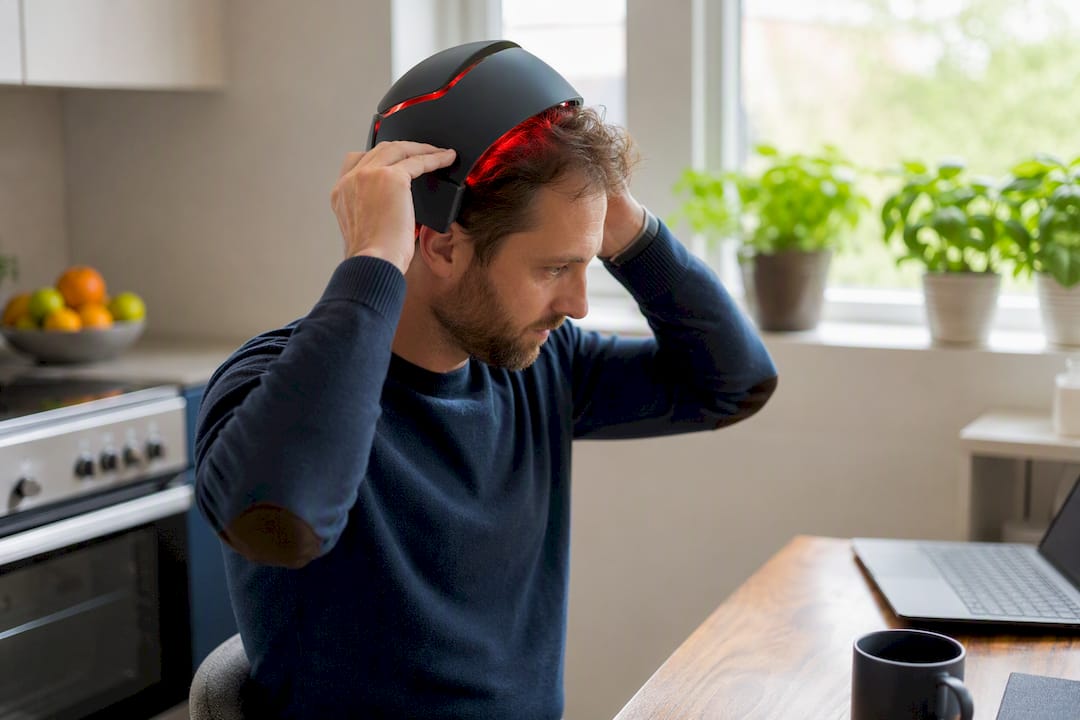
Red light therapy can help stimulate regrowth in early-to-moderate thinning when the follicles are still alive, but it will not resurrect a follicle that has scarred over or died. That single distinction separates realistic expectations from disappointment. Multiple randomised controlled trials back low-level laser therapy (LLLT) for androgenetic alopecia, the pattern hair loss affecting both men and women, though results take time and depend heavily on device quality and consistency.
Here is what the evidence actually shows:
- Shedding typically slows within 2 to 3 months of regular use.
- Visible density changes tend to appear between 3 and 6 months.
- Gains plateau around 6 to 12 months and require ongoing sessions to hold.
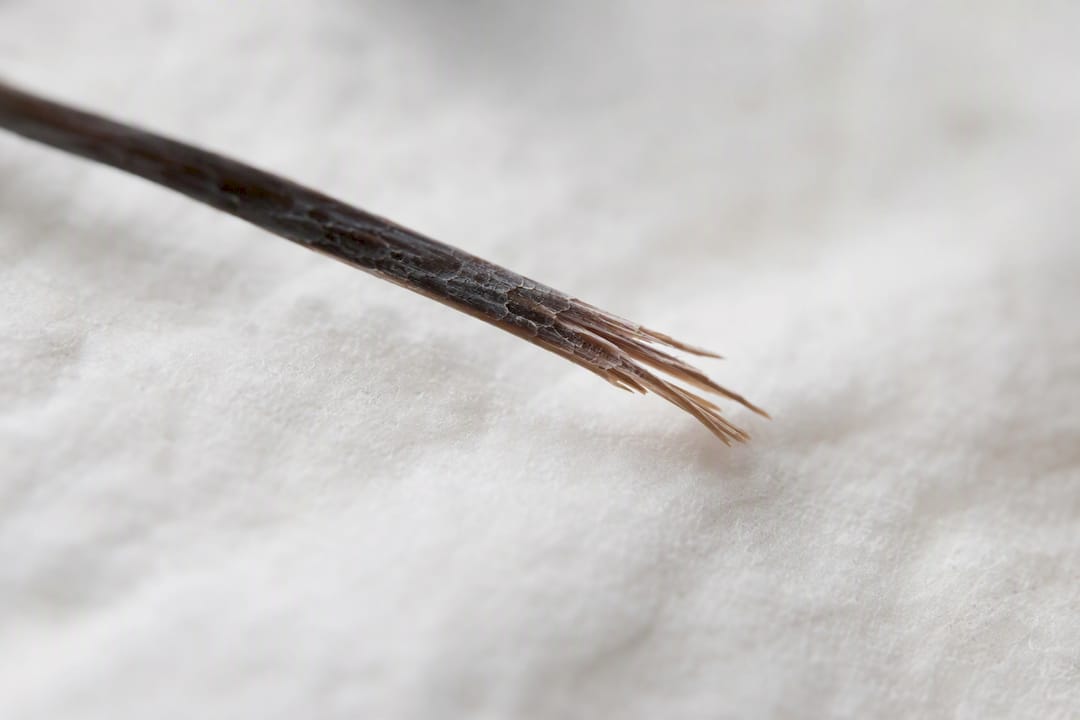
- It will not help scarring alopecia, dead follicles, or hair loss from unrelated medical causes.
- A medical-grade at-home device, such as Livdor’s laser hair growth cap, can deliver clinic-comparable wavelengths without the appointment.
If your thinning is early and your scalp shows no scarring, red light therapy for hair is worth serious consideration. If hair loss came on suddenly or your scalp looks inflamed or scarred, see a dermatologist before buying any device.
Key Takeaways
Red light hair therapy works by reactivating viable but dormant follicles through photobiomodulation, and it delivers the strongest results when used consistently for 12 to 16 weeks or longer alongside supportive scalp care.
| Point | Details |
|---|---|
| Evidence is trial backed | RCTs report 35 to 39% higher hair counts than sham treatment using helmet-style LLLT at around 655 nm. |
| Timeline needs patience | Expect reduced shedding by 2 to 3 months and visible thickening between 3 and 6 months. |
| Wavelength and power matter | Look for devices stating 630 to 670 nm, with published power density and session protocols. |
| Best as part of a routine | Pairing LLLT with biotin, caffeine, and rosemary and saw palmetto products supports scalp health alongside device use. |
| Livdor offers a trial-aligned option | Livdor’s 650 nm laser cap uses 272 medical-grade lasers and pairs with supporting serums and supplements for a complete routine. |
This article is general information, not a substitute for advice from a qualified doctor. Consult a qualified healthcare professional about your own circumstances before acting on anything here.
What the science says about red light for hair growth
The strongest evidence comes from a randomised trial using a helmet-style LLLT device at roughly 655 nanometres, which found hair counts increased by 35 to 39% compared with sham treatment after 16 weeks of use. Participants used the device for around 25 minutes every other day, a protocol that has since become the reference point for at-home dosing schedules. That is not a marginal effect. It is the kind of number that makes a therapy worth a place in a serious hair loss routine rather than a novelty gadget.
In the numbers: RCT data shows a 35 to 39% relative increase in hair count over sham treatment using helmet-style LLLT at approximately 655 nm over 16 weeks.
A separate multicentre controlled study reinforced those findings, reporting improved hair density and thickness with helmet-like devices and no serious adverse events across the trial period. Consistency across two independently run trials matters more than either result alone.
Where does the evidence get thinner? Three areas stand out:
- Non-pattern hair loss. Trials focus almost entirely on androgenetic alopecia, so extending claims to alopecia areata, telogen effluvium, or scarring conditions is not supported.
- Long-term safety data. Most trials run 16 to 26 weeks. Data beyond a year of continuous home use is limited, though nothing in the existing research suggests cumulative risk.
- Consumer device standardisation. Stanford Medicine’s review notes that clinic-grade devices are typically far more powerful than consumer options, and the market lacks consistent labelling of irradiance or dose.
The American Medical Association takes a measured position: LLLT has reasonable support for pattern hair loss specifically, but patients should be wary of broader claims made for other skin or hair conditions. That caution is worth repeating to anyone tempted by a device marketed as a cure-all.
How does red light hair therapy actually work?
The mechanism has a name: photobiomodulation. Red and near-infrared light in a specific wavelength band penetrates the scalp and gets absorbed by mitochondria inside hair follicle cells, boosting production of adenosine triphosphate (ATP), the molecule cells use as fuel. More available energy means follicle cells can do more, including re-entering the active growth phase.
Hair growth runs in cycles. Follicles move through anagen (active growth), catagen (transition), and telogen (rest), and in pattern hair loss, an increasing share of follicles get stuck in telogen or shrink through miniaturisation. Photobiomodulation appears to nudge dormant but still-viable follicles back into anagen rather than creating new follicles from scratch. That is why early intervention works better: a follicle that has already scarred shut has nothing left to recruit.
Laboratory work using 650 nanometre red light on human hair follicles found measurable increases in hair-shaft elongation and cell proliferation markers, alongside gene-expression changes tied to Wnt signalling, a pathway heavily involved in hair follicle cycling. That is the biological reason 630 to 670 nanometres, with many devices centring on 650 nm, dominates device design rather than shorter or longer wavelengths.
- Wavelength determines how deep the light travels and which cellular structures absorb it.
- Coherent laser light (as opposed to scattered LED light) tends to penetrate more precisely, which is why laser diode caps are often positioned above LED-only panels for scalp use.
- Power density affects how much energy actually reaches the follicle in a given session, not just how bright the device feels.
Pro Tip: More exposure is not automatically better. Dose-response for LLLT and hair growth is not linear, so doubling your session length will not double your results and may just waste your evening.
Types of red light hair devices and what separates them
Not every product marketed for hair sits in the same category, and the differences matter more than most marketing pages admit. LLLT devices use laser diodes, which emit coherent, focused light at a specific wavelength. LED-only devices scatter light across a broader area at lower intensity per point. Both can work, but laser diodes generally deliver more concentrated energy to the follicle, which is one reason the American Hair Loss Association points to laser-based LLLT as the more reliable configuration for regrowth.
Devices used in successful trials publish exact wavelength and dosing figures. If a product page will not state its wavelength range or session dose, that omission is itself useful information.
Form factor shapes how evenly light reaches the scalp:
- Caps and helmets cover the whole scalp at once, useful for diffuse thinning across the crown and hairline.
- Combs target specific patches but require moving the device manually, which makes consistent dosing harder to guarantee.
- Panels work well for facial or topical skin use but are awkward for full scalp coverage through hair.
When comparing devices, check five things: the stated wavelength (look for 630 to 670 nm), power density or irradiance, the number of diodes, the recommended session length and frequency, and whether the manufacturer references FDA clearance for hair growth devices. A device that cannot answer these clearly, or leans on vague phrases like “advanced light technology,” is a device with something to hide. Warranty length is a decent proxy for manufacturer confidence too.
Treatment protocols: how long until you see results?
Trial protocols give the clearest template for at-home use. The landmark helmet study used sessions of roughly 25 minutes, every other day, for 16 consecutive weeks, and that cadence has become the practical benchmark most credible devices now build their instructions around.
What should you actually expect, week by week?
- Weeks 1 to 8: Little visible change, though many users report reduced shedding starting around the 8 to 12 week mark.
- Months 3 to 6: Visible thickening becomes noticeable in the majority of responders, according to practitioner commentary summarising typical patient timelines.
- Months 6 to 12: Results tend to plateau, representing close to the ceiling of what the therapy alone will achieve for a given person.
- Beyond 12 months: Continued use is necessary to maintain gains. LLLT does not confer permanent results the way a one-off procedure might; stop sessions and the follicles you recruited can drift back towards dormancy.
Patience matters here more than intensity. Skipping doses erratically, or trying to compress a 16-week protocol into four weeks of daily marathon sessions, will not accelerate anything and may simply waste the device’s lifespan.
Pro Tip: Take a photo under the same lighting, same time of day, once a month, and keep a simple shedding log during washes. Memory is a poor judge of gradual change, and a photo record will show progress your eyes miss week to week.
Safety, side effects, and who should skip it
LLLT has a favourable safety record across trial periods, and the multicentre controlled study reported no serious adverse events among participants. That said, real usage still comes with a short list of things to watch for.
- Mild scalp warmth or tightness during a session, usually resolving quickly after use.
- Occasional dryness or minor irritation, particularly with overuse beyond recommended session lengths.
- Temporary redness in some users, more likely reported among people with darker skin tones, according to AMA guidance, which recommends starting with shorter exposures and increasing gradually while monitoring for persistent colour change.
- Always follow the manufacturer’s eye-safety instructions; direct sustained eye exposure to laser light sources should be avoided regardless of the device.
See a clinician before starting if hair loss appeared suddenly, if your scalp shows scaling, pustules, or scarring, or if you suspect an underlying condition such as alopecia areata or a thyroid disorder. Red light will not help hair loss caused by scarring or by follicles that have already died, and no legitimate device will claim otherwise.
Combining red light with supporting hair growth products
A laser cap addresses the follicle directly, but the scalp environment around it still needs support. Clinical and expert commentary generally favours a multi-modal routine: healthy scalp conditions, adequate nutrient supply, and reduced breakage all give red light therapy a better foundation to work from.
A sensible at-home routine layers products by function rather than throwing everything on at once:
- Rosemary and saw palmetto conditioner supports scalp condition and may help address some of the hormonal factors linked to pattern thinning, used as a rinse-out step after cleansing.
- Biotin and caffeine shampoo cleanses gently while delivering nutrients associated with hair strength directly to the scalp.
- A hair growth serum with biotin, caffeine, and Pro-Vitamin B5 applies after cleansing and before or after the laser session, targeting the scalp with leave-in nutrient support.
- Biotin gummies cover nutritional support from the inside, useful for anyone whose diet may fall short on the building blocks hair needs.
A practical sequence: cleanse with a biotin and caffeine shampoo, apply the laser cap for the session, then follow with a leave-in serum once the scalp has cooled. Always check individual product instructions, since some topicals recommend application on dry hair before device use rather than after. For more detail on drug-free approaches that pair well with this kind of routine, Livdor’s guide to pharmaceutical-free hair treatments is a useful next read. For a broader look at at-home light therapy practice, this overview of red light therapy applications covers general best practice beyond hair specifically.
How to choose a red light device or clinic
Comparing red light hair loss treatment options gets easier with a short checklist rather than a scroll through marketing pages. Before buying anything, confirm the following:
- Wavelength stated clearly, ideally within the 630 to 670 nm range, with many credible devices centring on 650 nm.
- Power density or irradiance published, not just diode count, since more diodes at low power will not necessarily outperform fewer diodes at correct intensity.
- A defined treatment protocol covering session length, frequency, and expected duration before reassessment, mirroring trial-based schedules.
- Reference to FDA clearance for hair growth use, which signals the manufacturer has cleared a regulatory bar rather than relying on vague wellness language.
- A meaningful warranty and clear aftercare support, which tends to correlate with manufacturers confident their device performs as claimed.
A supplier who answers these questions specifically, with numbers rather than adjectives, is telling you something. A supplier who dodges them with phrases like “clinically inspired technology” is also telling you something.
If your hair loss is recent, patchy, or accompanied by scalp symptoms, see a dermatologist before buying a device rather than after. Otherwise, the decision flow is straightforward: confirm you are a reasonable candidate for home use, commit to consistent sessions for at least 12 to 16 weeks, then reassess with photos and a shedding log at the 3 to 6 month mark before deciding whether to continue or escalate to a clinician.
Where red light fits against minoxidil and finasteride
Finasteride is FDA-indicated for men only. Women who are or may become pregnant must not handle crushed or broken finasteride tablets, due to the risk of harm to a male fetus. It can also cause sexual side effects (reduced libido, erectile dysfunction) in a minority of men, which usually resolve after stopping treatment. Discuss these risks with a physician before starting.
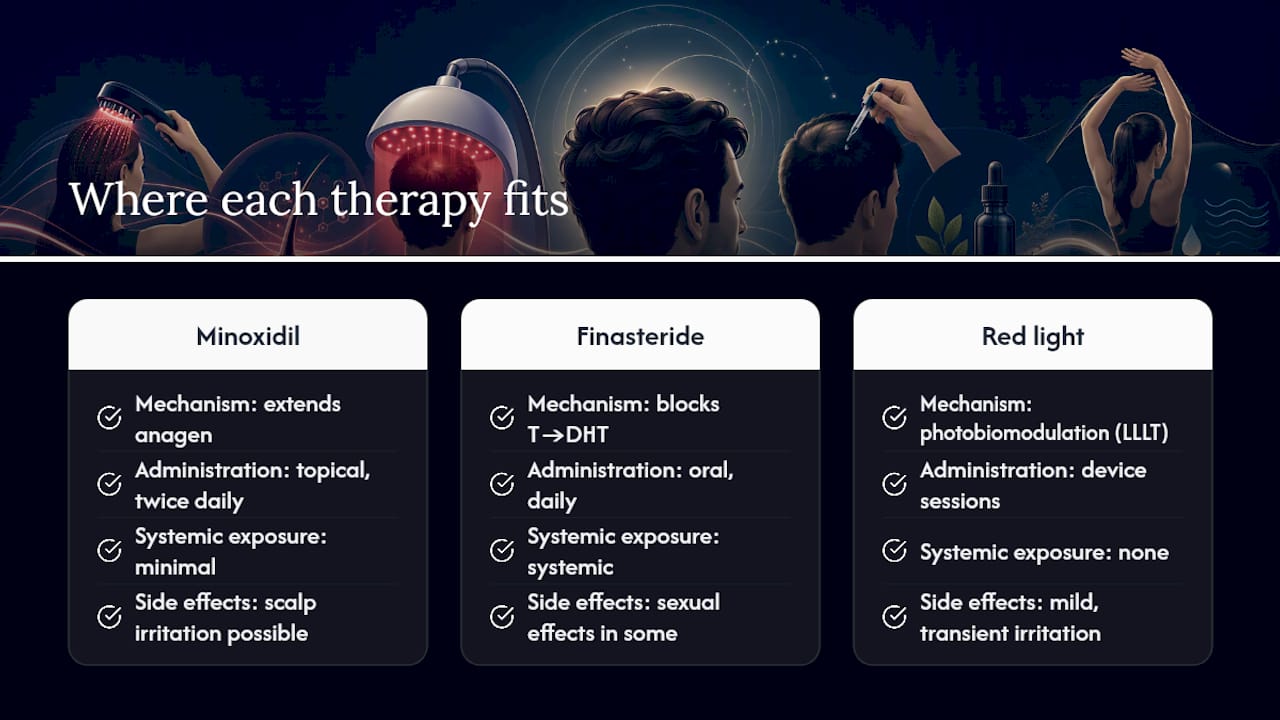
Red light therapy is not competing head-to-head with pharmaceutical options so much as occupying a different lane. Minoxidil works by extending the anagen phase through a vascular mechanism and requires twice-daily topical application indefinitely. Finasteride works systemically by blocking the conversion of testosterone to DHT, the hormone most implicated in pattern hair loss, and carries a documented profile of side effects for some users. Red light therapy, by contrast, works through photobiomodulation with no systemic drug exposure and a side effect profile limited mostly to mild, transient scalp irritation.
The RCT evidence for LLLT does not claim to outperform finasteride’s hormonal effect, but it does offer something drug-based options cannot: a drug-free mechanism suitable for people who want to avoid systemic treatment altogether, or who want to add a complementary approach alongside one they already use. Many dermatology commentators view LLLT as an adjunct rather than a replacement, which is precisely why the multi-modal routine described earlier tends to outperform any single intervention used in isolation.
A practical view on patience and consistency
The gap between what clinics achieve and what happens at home usually comes down to one thing: consistency, not device power. A clinic session might use a stronger unit, but a home device used every other day for four months will often outperform an occasional clinic visit squeezed in when time allows.

Nobody wants to hear that hair regrowth takes months rather than weeks. But the trial data is consistent on this point, and rushing the protocol, or abandoning it at week six because nothing has changed yet, is the single most common reason people conclude red light “did not work” when it was never given a fair run.
Combine the device with proper scalp support rather than expecting the light alone to compensate for a poor routine elsewhere.
A clinic-grade laser cap you can use at home
Livdor’s laser hair growth cap uses 272 medical-grade lasers set within the 650 nm range that trial data consistently supports, built for anyone managing early-to-moderate thinning who wants a device engineered around published wavelength and dosing parameters rather than vague marketing copy.
It suits readers who have ruled out scarring or sudden hair loss and want a consistent, drug-free routine they can run from home. Pairing the cap with Livdor’s supporting range, including rosemary and saw palmetto conditioner, biotin and caffeine shampoo, a Pro-Vitamin B5 serum, and biotin gummies, builds the kind of multi-modal routine this article has pointed to throughout. Every device ships with a warranty and aftercare support, so you are not left guessing if something feels off. If you are ready to start a proper 12 to 16 week protocol, browse the full laser hair growth product range and build a routine suited to where your thinning currently stands.
Sources
- The growth of human scalp hair mediated by visible red light laser and LED sources in males
- Red light therapy: What the science says - Stanford Medicine
- 6 things patients should know about red light therapy | AMA
- Understanding the differences between red light therapy, LED caps, and LLLT devices - AHLA
FAQ
Is red light actually good for your hair?
Yes, for early-to-moderate pattern hair loss with viable follicles. RCTs show meaningful hair-count increases with consistent use, though it will not help follicles that have already died or scarred.
Can you overdo red light therapy for hair?
Longer or more frequent sessions than trial protocols recommend do not produce better results and may just waste time, since dose-response for LLLT is not linear. Stick to the manufacturer’s recommended session length and frequency.
What did Elon Musk use to regrow his hair?
Musk has publicly attributed some of his hair changes to finasteride, a prescription medication, rather than red light therapy specifically. Red light hair devices operate through a different, drug-free mechanism and are not the same intervention.
What are the side effects of red light therapy on hair?
Most users report mild, temporary effects such as scalp warmth or dryness, with no serious adverse events reported across major trial periods. People with darker skin tones should start with shorter sessions and watch for persistent redness or pigmentation change.
How does red light compare with minoxidil or finasteride for hair loss?
Red light works through photobiomodulation with no systemic drug exposure, while minoxidil and finasteride work through vascular and hormonal mechanisms respectively. Many practitioners treat LLLT as a complementary addition rather than a direct substitute for either.


Leave a comment
This site is protected by hCaptcha and the hCaptcha Privacy Policy and Terms of Service apply.