

The most effective drug-free hair restoration protocol combines a high-quality LLLT laser cap used daily, a targeted topical serum applied post-shower, and evidence-backed supplements taken only when bloodwork confirms a deficiency. Add scalp massage, a clean cleansing routine, and sound nutrition, and you have a regimen that can produce measurable results within three to six months for people with early to moderate thinning.
The core components covered in this article:
- LLLT laser cap (650nm, medical-grade diodes) used daily or as directed
- Targeted hair growth serum with biotin, caffeine, and Pro-Vitamin B5
- Scalp microneedling to prime follicles and improve serum absorption
- Daily scalp massage for circulation and follicle stimulation
- Rosemary, saw palmetto, and caffeine topicals (shampoos, conditioners)
- Supplements (biotin gummies, hair growth vitamins) only after confirming deficiencies via bloodwork
- Nutrition, sleep, and stress management as the foundation
- PRP/PRF and emerging regenerative options for those wanting in-clinic support
TL;DR: Expect visible changes from around three months with daily compliance. You are the best candidate if you have early or mild-to-moderate thinning; the longer follicles have been dormant, the harder any non-surgical approach will work.
What are the main drug-free hair restoration options, and how do they work?
Understanding the mechanism behind each approach helps you choose the right combination rather than chasing the most-hyped option.

Low-level laser therapy (LLLT)
LLLT uses red or near-infrared light, typically at 650nm, to stimulate the mitochondria inside hair follicle cells. The result is increased cellular energy (ATP), improved blood flow to the scalp, and a nudge for follicles sitting in the resting (telogen) phase to re-enter active growth (anagen). At-home devices come in two main forms: laser caps, which sit on the head hands-free for a set session, and laser combs, which require manual movement across the scalp. Laser caps are generally preferred because they deliver consistent, even coverage without user error, and adherence is materially better with hands-free devices.
Autologous platelet therapies: PRP and PRF
Platelet-rich plasma (PRP) and platelet-rich fibrin (PRF) are both derived from a small sample of your own blood, spun in a centrifuge to concentrate growth factors. PRP is the older, more studied technique; PRF is a second-generation refinement that produces a slower-release fibrin matrix, potentially delivering growth factors to the scalp over a longer period. Both are administered by injection into the scalp in a clinic setting. A typical course involves multiple sessions spaced weeks apart, followed by maintenance sessions every few months. Neither is available as an at-home treatment.
Scalp microneedling
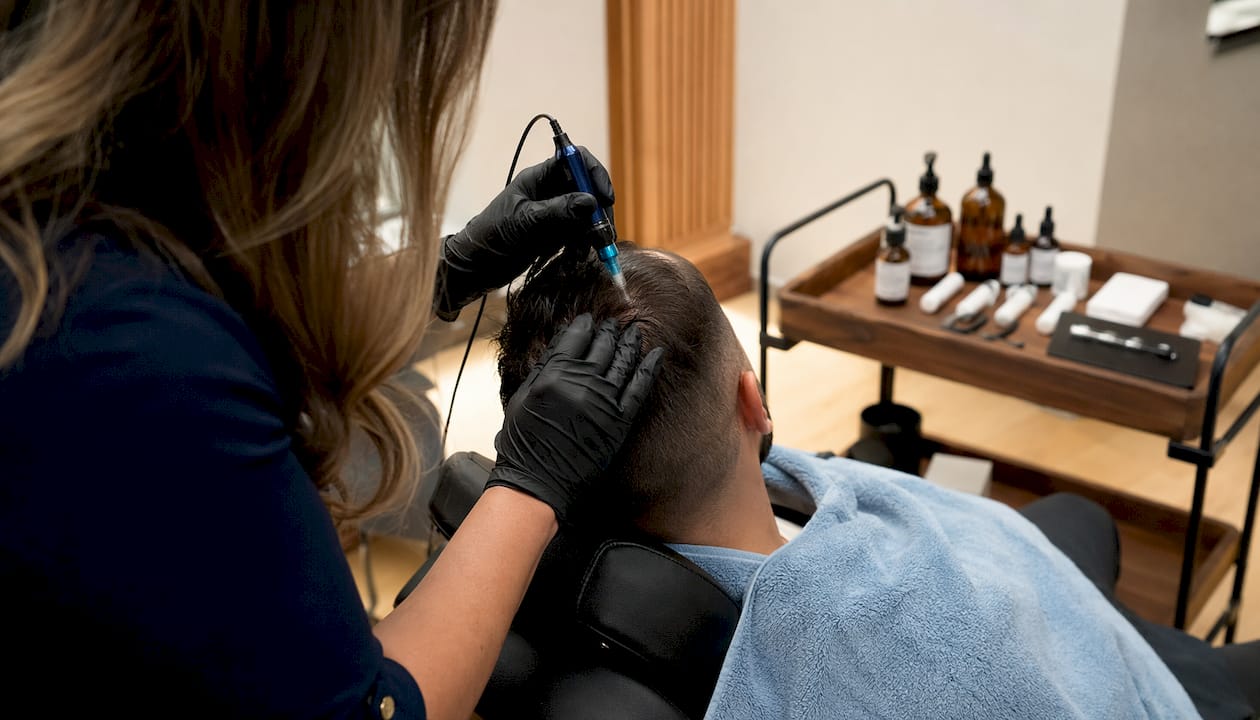
Microneedling uses a dermaroller or motorised pen to create tiny, controlled micro-injuries across the scalp. This triggers a wound-healing response that releases growth factors locally and, critically, increases the permeability of the scalp so that topical serums applied immediately afterwards absorb far more effectively. Sessions are typically done once a week at home (using shorter needles, 0.25–0.5mm) or monthly in a clinic (longer needles, 1.0–1.5mm). Microneedling pairs particularly well with LLLT and topical serums.
Emerging regenerative options
Exosome therapy and stem-cell-derived treatments are generating genuine interest in hair restoration research, but both remain experimental. Neither has the volume of controlled trial data that LLLT or PRP carries, and neither is currently regulated as a standard clinical treatment in the UK. Approach any clinic offering these as a proven solution with caution, and ask to see the specific trial data they are drawing on.
How each method fits different stages of hair loss:
- Early thinning (Norwood I–III / Ludwig I): LLLT, topicals, supplements, scalp massage, and microneedling are all appropriate and can produce meaningful results.
- Moderate thinning (Norwood III–IV / Ludwig II): LLLT remains useful; PRP/PRF adds in-clinic support; combination protocols are most effective.
- Advanced or long-standing loss (Norwood V+ / Ludwig III): Non-surgical options are less likely to restore fully dormant follicles; a trichologist or dermatologist consultation is strongly recommended before investing in any protocol.
What does the evidence say, and when can you expect results?
Honest expectations are the difference between staying consistent and abandoning a protocol too soon.
Relative strength of evidence
LLLT has the strongest evidence base among drug-free at-home options, supported by multiple randomised controlled trials and device clearances in several markets. PRP and PRF are backed by systematic reviews, though protocols vary enough between clinics that outcomes are less predictable. Rosemary oil has a small but credible body of trial data for androgenetic alopecia (AGA). Nutraceuticals show real promise when deficiency is present: a six-month prospective study in women found mean relative increases in linear hair growth rate of approximately 18%–37% above baseline using multi-targeting hair growth nutraceuticals. A separate pilot trial in women with telogen effluvium reported a 28% reduction in shedding after six months with a drinkable food supplement.
Statistic to know: In the nutraceutical study above, objective improvements in hair growth rate were sustained through day 180, suggesting that benefits accumulate with continued use rather than plateauing early.
It is worth being clear-eyed here. Industry experts and clinicians consistently note that established medications remain the most thoroughly studied options for moderate-to-advanced AGA, and that drug-free approaches generally do not match them head-to-head at that stage. Drug-free methods are best positioned as a genuine first line for early thinning, a maintenance layer for those who have stabilised, or a complement to medical treatment for those who choose it.
Timeline checkpoints
- Month 1–2: Scalp condition often improves first. Some people notice a temporary increase in shedding as dormant follicles re-enter anagen; this is a normal sign of activity, not harm.
- Month 3: The earliest visible changes typically appear. Hair may feel thicker at the root before length increases noticeably.
- Month 6: The most meaningful checkpoint. Photograph the same area in the same lighting and compare directly. Most people who respond to LLLT or nutraceuticals will have clear evidence by now.
- Month 12: Full assessment. If there has been no measurable change after twelve months of consistent use, consult a trichologist to reassess the cause and consider whether additional options are appropriate.
Who benefits most
People with early or mild-to-moderate AGA, telogen effluvium (stress- or deficiency-driven shedding), or post-partum hair loss tend to respond best. Some forms of hair loss, including telogen effluvium and mild alopecia areata, can remit without any medical therapy at all once the underlying trigger is removed. Follicles that have been completely dormant for many years are far less likely to respond to stimulation alone.
Measuring progress:
- Take standardised photographs every four weeks (same lighting, same angle, same distance).
- Count hairs in a defined 1cm² area if you want objective data.
- Ask a trichologist for a trichoscopy assessment at baseline and at six months.
Which topical actives and supplements actually support hair growth?
The market for hair supplements is crowded and, frankly, oversold. Here is what the evidence supports and when it applies.
Topical options worth using
Rosemary oil (2%) has trial data showing comparable results to minoxidil 2% for AGA over six months, with fewer scalp side effects. Apply two to three drops to the scalp, massage in, and leave for at least thirty minutes before washing, or use a rosemary-infused conditioner daily. Livdor’s Saw Palmetto and Rosemary Shampoo and Rosemary Conditioner with Saw Palmetto deliver both actives in a format that fits a normal wash routine without any extra steps.
Caffeinated shampoos work by temporarily blocking DHT at the follicle level and improving scalp circulation. The key is contact time: leave the shampoo on for two to three minutes before rinsing. Livdor’s Caffeine Shampoo is formulated specifically for this, and using it consistently as part of your cleansing routine adds a meaningful layer to any protocol.
Hair growth serums with biotin, caffeine, and Pro-Vitamin B5 (panthenol) address the follicle from the outside in. Biotin supports keratin production, caffeine stimulates the follicle, and panthenol strengthens the hair shaft and improves moisture retention. Livdor’s Hair Growth Serum combines all three in a lightweight formula designed to be applied to a clean, damp scalp after showering. Apply it before your LLLT session if you are using a laser cap in the evening, or immediately after microneedling to maximise absorption.
Plant-based topical serums from other reputable suppliers can also complement a protocol. The Voraly Bio-Active Veganic Serum is one example of a plant-derived topical that fits a hormone-free approach for those wanting additional options.
Supplements: when they help and when they do not
The single most important rule: supplement only where bloodwork confirms a deficiency. Taking biotin when your levels are already normal offers no proven benefit and can interfere with thyroid and cardiac diagnostic assays, which is a real clinical risk. The same principle applies to zinc and vitamin D.
- Biotin gummies: Support keratin infrastructure. Useful when biotin levels are low, which is more common than most people realise in those with restrictive diets or gut absorption issues.
- Hair growth vitamins: A well-formulated multi-targeting supplement covering iron, zinc, vitamin D, selenium, and B-vitamins addresses the most common deficiency-related causes of shedding in one daily dose.
- Saw palmetto: Inhibits 5-alpha reductase, the enzyme that converts testosterone to DHT. Evidence is modest but consistent for mild AGA; it is a reasonable addition for those who want a hormone-free approach to DHT management.
- Pumpkin seed oil: Similar mechanism to saw palmetto; small trials show positive effects on hair count in men.
Pro Tip: Before starting any supplement routine, ask your GP for a full blood panel covering ferritin, vitamin D, zinc, and thyroid function. Low ferritin is one of the most commonly missed drivers of hair shedding in women, and correcting it alone can produce a significant improvement.
Layering your regimen
The most effective sequence is: cleanse with a biotin or caffeine shampoo, condition with a rosemary/saw palmetto conditioner, towel-dry, apply serum to the scalp, then run your LLLT cap session. On microneedling days, apply serum immediately after needling and skip the laser cap for twenty-four hours to avoid over-stimulating the scalp.
Daily habits and lifestyle changes that support your protocol
No device or serum works well on a neglected scalp. The foundation matters.
Scalp care basics
Keep your scalp clean but not stripped. Washing every two to three days with a gentle biotin shampoo or caffeine shampoo removes sebum and product build-up without disrupting the scalp’s natural barrier. Avoid sulphate-heavy formulas, excessive heat styling, and tight hairstyles that create traction on the follicle. Livdor’s Biotin Shampoo and Biotin Conditioner are formulated to cleanse gently while delivering follicle-supporting actives with every wash.
Scalp massage: the evidence
Daily scalp massage has a credible evidence base. A structured technique of four minutes per day using firm, circular fingertip pressure has been associated with increased hair thickness in small trials. The mechanism is likely a combination of improved dermal blood flow and mechanical stretching of follicle cells. Do it in the shower while your shampoo is on, or dry before your LLLT session. Consistency matters more than technique perfection.
Nutrition and sleep
- Protein: Hair is almost entirely keratin. Aim for at least 1.2–1.6g of protein per kilogram of body weight daily from varied sources.
- Iron and ferritin: Low ferritin is a leading cause of diffuse shedding, particularly in women. Red meat, lentils, and dark leafy greens are the most accessible dietary sources.
- Vitamin D: Deficiency is extremely common in the UK, especially outside the summer months. A daily supplement of vitamin D is widely recommended by UK clinicians for the general population.
- Omega-3 fatty acids: Found in oily fish, flaxseed, and walnuts; support scalp health and reduce inflammation around the follicle.
- Sleep and stress: Chronic stress elevates cortisol, which can push follicles into the resting phase prematurely. Seven to nine hours of sleep and regular moderate exercise (which lowers cortisol) are not optional extras; they are part of the protocol.
Building a treatment matrix that sticks
Adherence is the single biggest predictor of outcome in drug-free regimens. The simplest way to stay consistent is to attach each step to an existing habit. LLLT cap session while watching television in the evening. Serum applied immediately after your post-gym shower. Supplements taken with breakfast. The less decision-making required, the more likely you are to keep going past the three-month mark where results begin to show.
Is it safe? Side effects, UK regulatory context, and red flags
Most drug-free hair restoration methods are well tolerated, but knowing what to expect protects you from both harm and unnecessary alarm.
Common side effects by modality
- LLLT: Mild scalp warmth or tingling during sessions; very rarely, temporary increased shedding in the first four to six weeks as follicles re-enter anagen. Both are self-limiting.
- Scalp microneedling: Redness and mild sensitivity for twenty-four to forty-eight hours after each session. Infection risk is low but real if needles are not sterilised properly; always use a clean, single-use or properly sanitised device.
- PRP/PRF: Injection-site discomfort, temporary scalp tenderness, and occasional bruising. Infection risk exists with any injectable procedure; this is why clinic standards matter.
- Topicals and supplements: Scalp irritation is possible with high-concentration rosemary oil if applied undiluted. As noted, biotin can interfere with certain blood tests.
UK regulatory context
In the UK, LLLT devices sold for home use are consumer products rather than regulated medical devices in the same category as prescription treatments. When choosing a device, look for suppliers who cite specific clinical trial data for their product, not just generic LLLT research. For in-clinic procedures such as PRP, ask whether the practitioner is a registered trichologist, dermatologist, or GP with specific training in hair restoration. The Institute of Trichologists and the Trichological Society both maintain registers of qualified practitioners in the UK.
Expert consensus guidance on hair transplantation emphasises that candidates should have received adequate medical or non-surgical treatment before considering surgery, and that comorbidities should be assessed individually. The same principle applies to any in-clinic hair procedure.
Red flags to watch for
- Clinics promising full regrowth in weeks or guaranteeing results without a consultation.
- Devices with no cited clinical data, no warranty, and no return policy.
- Supplements claiming to “cure” hair loss without any mention of bloodwork or deficiency.
- Any injectable procedure offered without a full medical history review or consent process.
How do you choose a device or clinic and stay consistent?
Choosing well at the start saves money and frustration later.
Questions to ask a clinic before booking
- What specific training does the practitioner hold in hair restoration, and are they registered with a recognised UK body?
- Which protocol do you use for PRP/PRF, and what results does your patient cohort typically see at six months?
- What is your aftercare process, and how do you monitor progress between sessions?
- Do you offer a consultation before committing to a full course?
- What are your contraindications, and do you screen for bleeding disorders or active scalp conditions?
How to choose an LLLT device
The key specifications to check are wavelength (650nm is the most studied and effective range for hair follicle stimulation), number of diodes (more diodes mean more even scalp coverage), and whether the device uses true lasers rather than LEDs, which penetrate tissue differently. Medical-grade claims should be backed by specific trial references, not just marketing language. A solid warranty (at least twelve months) and a clear return policy are non-negotiable; any reputable supplier will offer both.
Livdor’s Laser Hair Growth Cap uses 272 medical-grade lasers at 650nm, designed for hands-free daily sessions. The hands-free format is particularly important for adherence: you can wear it while doing something else, which removes the friction that causes people to skip sessions.
Typical cost expectations in the UK
At-home LLLT caps from reputable suppliers sit at a one-off cost that, spread over twelve months of daily use, is generally lower per session than a single PRP treatment. PRP sessions in UK clinics typically run across a course of three to four initial sessions, with maintenance sessions thereafter. Costs vary by clinic, location, and practitioner seniority. In-clinic microneedling with a trained practitioner costs more per session than at-home rollers but delivers deeper needle penetration and more controlled conditions.
Maintaining a combined protocol
- Daily: LLLT cap session (20–30 minutes), serum application, scalp massage.
- Every wash (2–3 times per week): Biotin or caffeine shampoo, rosemary/saw palmetto conditioner.
- Weekly: At-home microneedling (0.25–0.5mm), followed by serum.
- Daily: Supplements with breakfast (only where bloodwork supports use).
- Monthly: Progress photograph in standardised conditions.
- Every 6 months: Trichologist or GP review to assess progress and adjust the protocol.
Stacking complementary drug-free therapies consistently produces better outcomes than any single approach used alone, and the combination of LLLT with supportive nutraceuticals and topical serums is where the strongest real-world results are reported.
How Livdor’s products fit the recommended protocol
Livdor’s range is built specifically around the drug-free, non-surgical approach described throughout this article. Each product maps to a specific step in the protocol rather than being a standalone solution.
The core Livdor protocol:
- Laser Hair Growth Cap (650nm, 272 medical-grade lasers): The anchor of the regimen. Daily hands-free sessions deliver consistent LLLT coverage across the full scalp. The 650nm wavelength sits in the optimal range for follicle stimulation, and the 272-diode design means no patches of under-treated scalp.
- Hair Growth Serum (biotin, caffeine, Pro-Vitamin B5): Applied to a clean, damp scalp after showering or immediately after microneedling. The combination of biotin for keratin support, caffeine for follicle stimulation, and panthenol for shaft strength makes it a genuinely multi-active topical rather than a single-ingredient product.
- Caffeine Shampoo and Biotin Shampoo: Daily cleansing with an active benefit. The caffeine formula requires two to three minutes of contact time for best effect; the biotin shampoo suits those who prefer a gentler daily wash.
- Saw Palmetto and Rosemary Shampoo / Rosemary Conditioner with Saw Palmetto: Delivers the two best-evidenced plant actives for DHT management and follicle support in a format that fits a normal wash routine.
- Biotin Gummies and Hair Growth Vitamins: Targeted oral support for those with confirmed deficiencies. Livdor’s vitamins are manufactured in the UK to premium quality standards, covering the key micronutrients most commonly linked to hair shedding.
Livdor’s hair growth serum range and laser devices are designed to work together, and the brand works with UK trichology clinics to support combined protocols. For uncertain cases or more advanced thinning, Livdor recommends consulting a qualified UK trichologist before starting, and the Kirsty Hair and Care Trichology partnership offers a route to professional assessment alongside device use.
Realistic timeline: most people using the full protocol consistently see measurable improvement by month three, with the clearest results at month six. Results are best maintained by treating the protocol as ongoing care rather than a fixed course.
Key takeaways
Drug-free hair restoration works best as a consistent, multi-layered protocol anchored by daily LLLT, targeted topicals, and supplements confirmed by bloodwork, with realistic results visible from three to six months.
| Point | Details |
|---|---|
| LLLT is the anchor | A 650nm laser cap used daily is the most evidence-backed at-home drug-free device for hair follicle stimulation. |
| Bloodwork before supplements | Only supplement where ferritin, vitamin D, zinc, or biotin deficiency is confirmed; unnecessary supplementation offers no benefit and can skew lab results. |
| Expect results at 3–6 months | Visible changes typically begin around month three; the six-month mark is the most meaningful checkpoint for assessing progress. |
| Stack therapies for best results | Combining LLLT with a topical serum, scalp massage, and targeted supplements produces better outcomes than any single approach alone. |
| Livdor’s protocol | Livdor’s Laser Hair Growth Cap (650nm, 272 lasers), Hair Growth Serum, and UK-made vitamins map directly to the recommended drug-free protocol. |
The part most people get wrong
There is a pattern worth naming honestly. Most people who try drug-free hair restoration and give up do so between weeks six and ten, precisely when a temporary shedding phase can make things look worse before they improve. That shedding is usually a sign that follicles are re-entering the growth phase, not evidence that the protocol is failing. Abandoning at that point is one of the most common and most avoidable mistakes.
The second pattern is supplement overload. People read that biotin supports hair growth, buy the highest-dose gummy they can find, and take it without checking their baseline levels. If your biotin is already adequate, you are not adding anything useful, and you may be making your next thyroid blood test harder to interpret. The same logic applies to zinc: too much can actually suppress copper absorption and worsen hair loss. Targeted supplementation based on actual bloodwork is not a bureaucratic hurdle; it is the difference between a supplement that helps and one that does nothing or causes harm.
The third pattern is expecting a device or serum to compensate for a diet that is chronically low in protein or iron. No topical or laser can build hair from nutrients that are not there. The lifestyle foundation is not the boring part of the protocol; it is the part that determines whether everything else works.
My practical recommendation: start with the LLLT cap and a good serum, get your bloodwork done in the first month, and add supplements only where the results justify it. Keep the protocol simple enough that you will actually do it every day. Complexity is the enemy of adherence, and adherence is what produces results.
Livdor’s drug-free hair restoration range
If you have read this far, you already know what a well-designed drug-free protocol looks like. Livdor exists to make that protocol as straightforward as possible to follow at home, without compromising on the quality of the science behind it.
The Laser Hair Growth Cap uses 272 medical-grade lasers at 650nm, comes with a full warranty, and is delivered to your door across the UK. Pair it with the Hair Growth Serum, a Caffeine or Biotin Shampoo, and Livdor’s UK-made Hair Growth Vitamins, and you have every layer of the recommended protocol covered in one place. The full laser hair growth product range is available to browse now, with clear product descriptions and guidance on how each item fits into a daily regimen.
Before combining any at-home protocol with in-clinic procedures such as PRP, speak to a qualified UK trichologist. Livdor’s trichology partnership page is a good starting point if you want professional guidance alongside your device use. Browse the range, check the clinical backing, and give yourself the full six months to see what a consistent, drug-free protocol can do.
Useful sources
The following references underpin the clinical claims in this article and are worth bookmarking for your own research or to share with a clinician.
- Hair transplantation — StatPearls / NCBI Bookshelf: Covers candidate selection, stabilisation requirements, and the role of non-surgical options including LLLT and PRP. Useful for understanding when surgery is and is not appropriate.
- Treatment matrix and adherence — PMC: Explains why protocol simplicity and automation (such as laser caps) improve long-term compliance and therefore outcomes.
- Supplements and biotin interference — PMC: Clinical review on when supplementation is appropriate and why biotin can skew diagnostic assays. Essential reading before starting any supplement routine.
- Hair loss: diagnosis and treatment — Mayo Clinic: Patient-facing guidance on causes, diagnosis, and treatment options including drug-free approaches. Good for understanding when spontaneous remission is possible.
- Multi-targeting nutraceuticals and hair growth rate — Dermatology and Therapy, Springer Nature: Six-month prospective study showing 18%–37% increases in linear hair growth rate in women using targeted nutraceuticals.
- Drinkable supplement and telogen effluvium — MDPI Journal of Clinical Medicine: Pilot trial reporting a 28% reduction in shedding and 12% increase in hair density after six months in women with TE.
- International expert consensus on hair transplantation — Europe PMC: Consensus recommendations on candidate selection, medical therapy prior to transplant, and post-procedure care; useful for understanding clinical standards.
- Livdor: how LLLT works: Clear explanation of the science behind Livdor’s laser devices and how 650nm light interacts with hair follicles.
- Nutritional deficiencies and hair loss — Livdor: Practical guidance on which blood tests to request and how deficiency-related shedding differs from AGA.
Bring your progress photographs, blood test results, and any specific questions from this article to your next GP or trichologist appointment. The more specific you can be, the more useful the consultation will be.
FAQ
Can you regrow hair without any drugs or surgery?
Yes, particularly in cases of early androgenetic alopecia, telogen effluvium, or deficiency-related shedding. LLLT, PRP, targeted topicals, and corrected nutritional deficiencies can all support regrowth, though results depend heavily on how early you start and the underlying cause.
How long does drug-free hair restoration take to show results?
Most people see the first signs of improvement around month three, with the clearest results at the six-month mark. Consistent daily use of an LLLT cap combined with a targeted serum and appropriate supplements gives the best chance of measurable progress by that point.
Is scalp microneedling safe to do at home?
At-home microneedling with shorter needles (0.25–0.5mm) is generally safe when you use a clean, properly sanitised device and follow aftercare guidance. Longer needles and deeper treatments are better left to a trained practitioner in a clinic setting to reduce infection risk.
What did Matthew McConaughey do about his hair thinning?
McConaughey has publicly credited a combination of scalp treatments and lifestyle changes for maintaining his hair, though he has not disclosed a specific clinical protocol. His approach aligns with the broader principle of early intervention and consistent scalp care rather than pharmaceutical treatment.
Why does Jennifer Aniston’s hair appear thinner now?
Aniston has spoken openly about hair thinning linked to stress and hormonal changes over the years. Diffuse thinning of this kind is typically telogen effluvium or age-related AGA, both of which respond well to the drug-free approaches covered here, particularly when addressed early with targeted nutrition, stress management, and topical support.


Leave a comment
This site is protected by hCaptcha and the hCaptcha Privacy Policy and Terms of Service apply.