
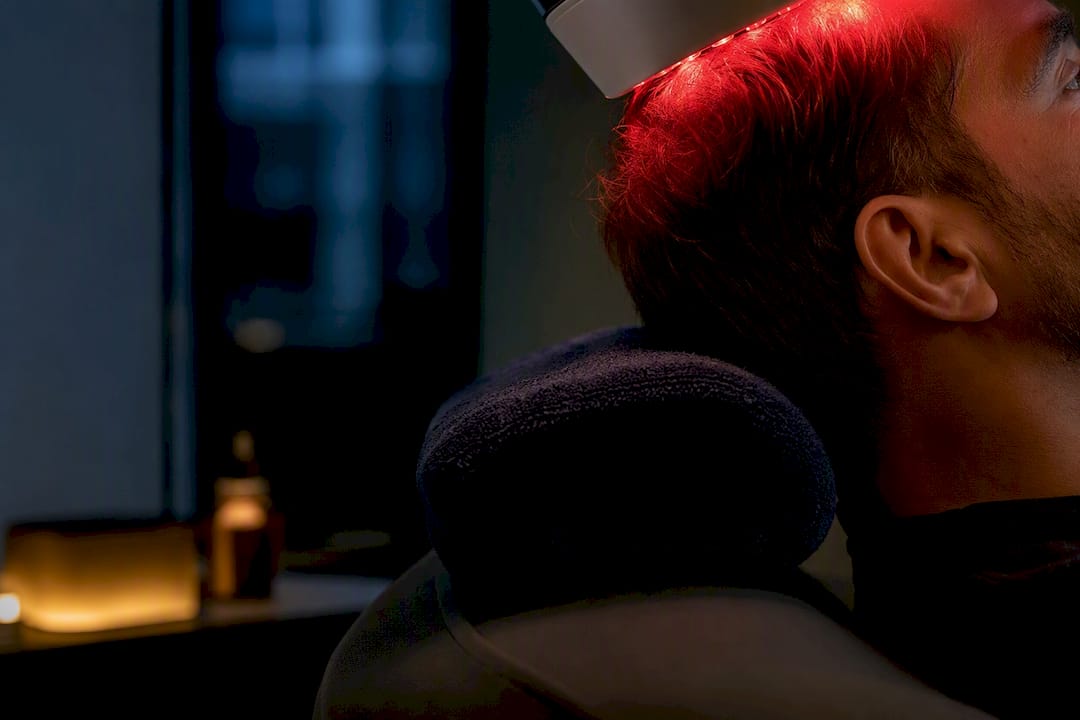
Yes, evidence shows LLLT can safely improve hair density and thickness for many people with pattern hair loss when used consistently. Visible change typically starts around three months, with clearer gains by nine to twelve months.
TL;DR:
- LLLT is most effective for individuals with active, miniaturised follicles typical of early to moderate androgenetic alopecia, not for completely bald or scarred areas.
- Devices with wavelengths between 635 and 675 nanometres and even diode distribution across the scalp are necessary for optimal results.
- Consistent use of about 20 to 25 minutes, three times per week, over at least four to six months is critical to see measurable improvements.
- Long-term studies show hair density can increase by roughly 25 hairs per square centimetre after 48 weeks of regular sessions.
- Combining LLLT with topical treatments like minoxidil or supportive supplements enhances outcomes, but devices alone do not guarantee regrowth in fully bald regions.
What is LLLT for hair loss, and how does it work?
Low-level laser therapy, often shortened to LLLT, uses red and near-infrared light at specific wavelengths to interact with cells in the scalp. It sits under the broader term photobiomodulation, which describes how light energy changes cell behaviour without generating heat or damaging tissue. If you have seen “red light therapy for hair loss” mentioned alongside LLLT, they refer to the same underlying mechanism.
The biology is more grounded than it sounds. Red light at these wavelengths gets absorbed by an enzyme called cytochrome c oxidase, sitting inside the mitochondria of your hair follicle cells. That absorption boosts ATP production, the cell’s basic energy currency, and triggers nitric oxide release. The knock-on effect is a follicle environment that’s more likely to stay in, or re-enter, the anagen (growth) phase rather than sliding prematurely into shedding.
Miniaturised follicles, the kind you get in early androgenetic alopecia, seem to respond best. They’re not dead, just weakened, and the added cellular energy appears to help them produce thicker shafts rather than the fine, wispy hairs typical of thinning areas.
Most of the published research clusters around wavelengths of roughly 635 to 675 nanometres, delivered through one of three device types:
- Combs, which you drag slowly across sections of scalp, dose-dependent on how thorough you are.
- Helmets or domes, self-contained but often heavier and pricier.
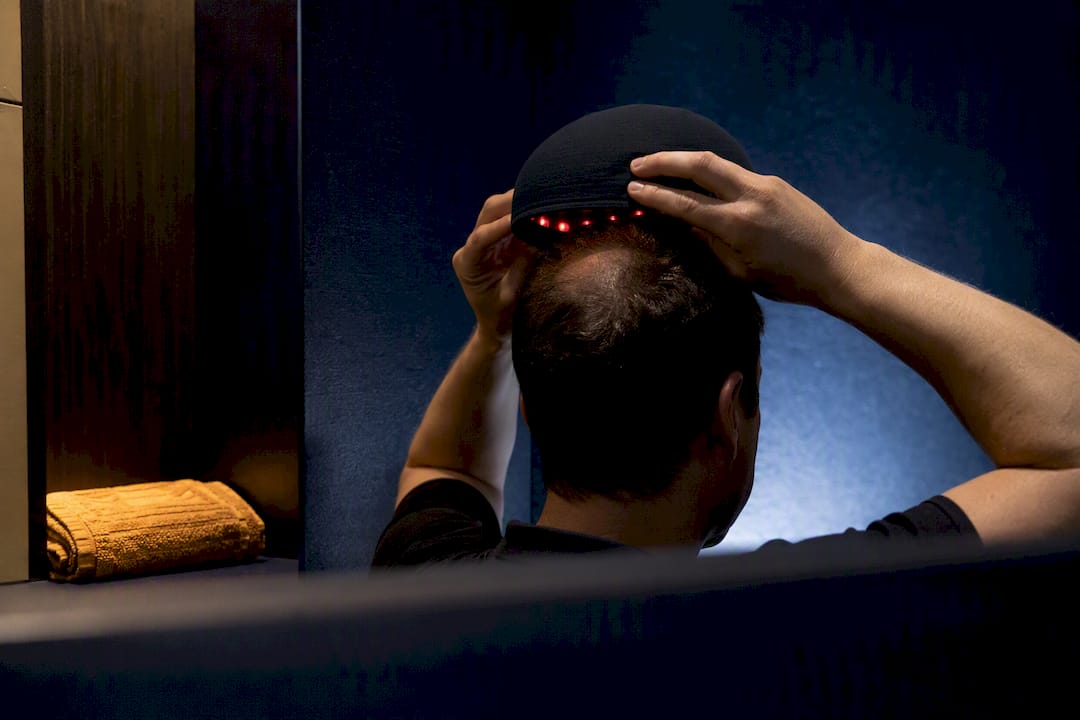
- Caps, flexible headgear that positions diodes close to the scalp across the whole crown and hairline in one sitting.
Coverage consistency matters as much as the wavelength itself. A device that under-delivers light to the temples while flooding the crown will produce uneven results, which is why diode placement and density are worth scrutinising before buying anything.
Pro Tip: Check whether a device states its wavelength range in nanometres and its total diode count with actual coverage mapping, not just a headline number. A cap advertising “272 lasers” means little without knowing how evenly they’re spread across the scalp.
What the research shows: RCTs, reviews and a 12-month trial
The clinical picture for LLLT is more substantial than most hair-loss interventions get. Multiple double-blind, sham-controlled randomised trials have measured hair count directly, rather than relying on self-reported satisfaction, and the numbers are consistent enough to take seriously.
In men, randomised trials using visible red light laser and LED sources reported hair-count increases of around 35 to 39% compared with sham devices over the study period. A separate double-blind RCT in women using a 655 nanometre device found a comparable 37% increase in terminal hair counts against sham at sixteen weeks. These are short-term studies, but the effect size shows up in both sexes and across different device designs, which strengthens confidence that the mechanism is doing something real rather than reflecting one lucky trial.
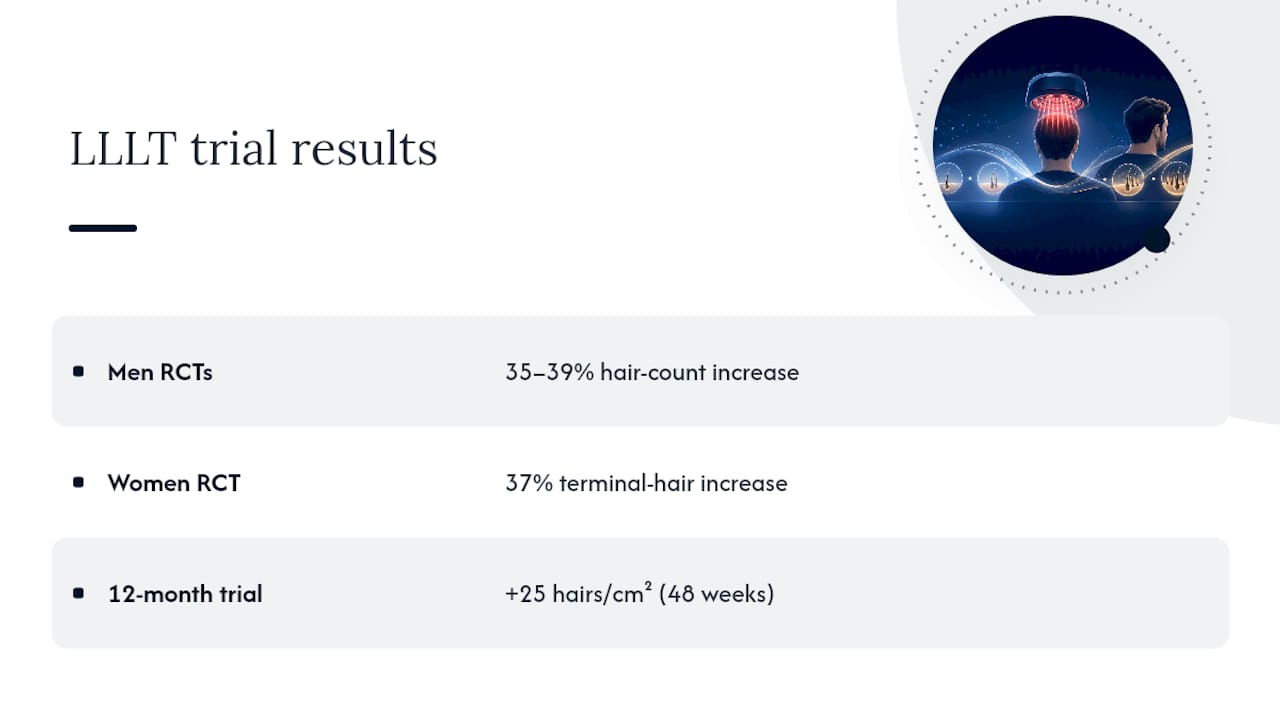
Longer data exists too. A 12-month prospective trial using a helmet device three times weekly found mean hair density rising from 99.2 to 124.2 hairs per square centimetre after 48 weeks, alongside a measurable improvement in shaft thickness. That’s the kind of gain that shows up in the mirror, not just on a statistician’s chart. It’s also one of the few LLLT studies to run long enough to capture whether early gains hold up rather than plateauing.
Zooming out from individual trials, a systematic review and meta-analysis of FDA-approved, home-use devices concluded that LLLT is potentially effective for pattern hair loss, while flagging that study quality varies considerably. Device wavelengths, session lengths, and trial durations differ enough between studies that pooling results cleanly is difficult. That heterogeneity doesn’t undermine the core finding so much as it limits how precisely anyone can promise a specific percentage gain to an individual reader.
In numbers: across the longest-running trial available, hair density climbed by roughly 25 hairs per square centimetre over 48 weeks of consistent, thrice-weekly LLLT use.
Clinical reviews of the role of LLLT in androgenetic alopecia describe it as a safe, non-invasive option that fits alongside topical therapies, though they’re careful to note the evidence base, while genuinely encouraging, still needs larger and more standardised trials before anyone can attach a single definitive number to expected results. What you can take from this honestly: the direction of the evidence is consistently positive, the mechanism has biological grounding, and the effect sizes reported are large enough to matter, but individual results will vary with device quality, consistency, and how advanced the thinning already is.
Who benefits most from LLLT?
The honest answer separates people who are likely to see real change from people who are chasing something LLLT was never built to deliver.
Good candidates typically have miniaturised but still active follicles. This describes most early-to-moderate androgenetic alopecia, whether it’s a receding hairline, a thinning crown, or diffuse thinning across the part line. The key word is active: if a follicle is still producing hair, even a thin, weak one, there’s living tissue for photobiomodulation to work with.
Poor candidates include anyone with long-standing, complete baldness in an area, or scalp affected by scarring alopecia. Research from Stanford Medicine makes the mechanism limit clear: LLLT cannot resurrect follicles that are fully fibrosed or scarred over. It’s a stabilisation and density treatment, not a way to regrow hair where none has grown for years.
Age, sex, and pattern all shape expectations somewhat:
- Younger users catching early thinning tend to see the most dramatic relative improvement, since more follicles are still salvageable.
- Women with diffuse thinning often respond well, as reflected in the female-specific trial data above.
- Men with advanced Norwood-scale patterns (typically stage 5 and beyond) usually see more modest results, since fewer active follicles remain in the bald zones.
- Anyone unsure where their thinning sits on that spectrum should get a scalp assessment from a clinician or trichologist before investing in a device, since a quick look under magnification tells you far more than guessing from the mirror.
Treatment protocols that actually match the trial data
Following a protocol that mirrors what was actually tested gives you the best shot at reproducing the results those trials reported.
The regimen used across most successful studies, including the 12-month prospective trial, runs to roughly 20 to 25 minutes per session, about three times a week on non-consecutive days. Wavelengths in the effective range cluster between 646 and 675 nanometres, with total light dose (measured in joules per square centimetre in some studies) also playing a role in outcomes, alongside the wavelength itself.
Here’s a realistic timeline based on trial patterns:
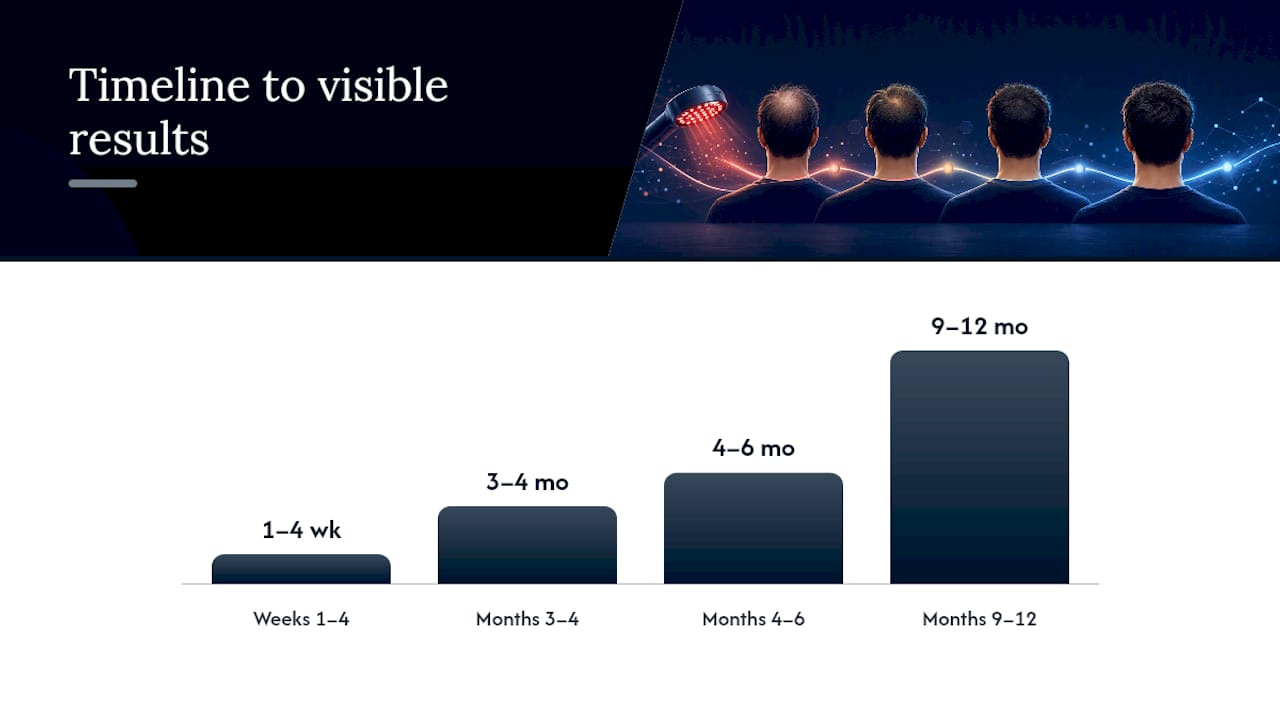
- Weeks 1 to 4: No visible change yet. Some users notice reduced shedding, which is often the first sign the treatment is doing something.
- Months 3 to 4: Early density improvements start to become measurable, though they’re often subtle enough that only side-by-side photos catch them.
- Months 4 to 6: Shaft thickness and density gains become clearer, matching the point where several trials first reported statistically significant differences from baseline.
- Months 9 to 12: The most substantial gains appear, consistent with the density increase recorded at 48 weeks in the long-term trial.
Tracking progress properly means resisting the urge to judge results from memory. Standardised photos, taken under the same lighting, same distance, same hair styling, at the same time each month, are the simplest way to catch gradual change your eye would otherwise miss. Some clinicians use phototrichogram imaging, which magnifies and counts follicles directly, for a more objective read.
Pro Tip: Set a calendar reminder for your baseline photo before you start your first session. Most people who feel LLLT “isn’t working” at month two simply have nothing to compare against and are relying on memory, which is notoriously unreliable for gradual change. For more detail on structuring sessions around your routine, this guide on how often to use red light therapy for hair regrowth breaks down scheduling in more depth.
Is LLLT safe? Side effects and who should be cautious
Safety data across trials is reassuring, and this is one of the stronger arguments for trying LLLT before more invasive interventions. The 12-month prospective trial reported no device-related adverse events and high adherence over the full year, which matters given how many hair-loss treatments cause people to quit early over side effects.
Where issues do appear, they’re typically minor and short-lived:
- Transient scalp irritation or mild pruritus (itching) in a small proportion of users, usually resolving without stopping treatment.
- Scalp warmth during sessions, which is normal and not a sign of tissue damage at the low power levels used in these devices.
- Serious adverse events are rare across the published trials, which is part of why reviews consistently describe LLLT as a safe, non-invasive option.
A few theoretical cautions are worth knowing even though trial data doesn’t flag them as common problems. If you’re using photosensitising topical medications, check with a pharmacist or clinician before adding light-based treatment, since combined effects haven’t been extensively studied. Active scalp infections, open sores, or unexplained scalp changes should be assessed by a doctor before starting any laser device, not because LLLT is inherently risky, but because self-treating an undiagnosed condition delays proper care.
For home use, sensible practical habits go a long way: keep the device clean between sessions, avoid sharing headgear with household members for hygiene reasons, and replace it once diodes visibly dim or stop working, since uneven output undermines the coverage consistency that made the trial results possible in the first place.
Combining LLLT with other treatments and supportive care
LLLT rarely works in isolation in the strongest studies. Several trials found additive benefit when LLLT was paired with topical minoxidil, though the evidence here comes with a caveat: not every study separated out how much of the improvement came from each treatment individually, so think of it as a reasonable combination rather than a guaranteed multiplier.
Supportive, non-drug measures tend to complement rather than replace laser therapy:
- Biotin supplementation supports the keratin infrastructure hair is built from, giving newly stimulated follicles the raw material to produce a stronger shaft.
- Caffeine-based serums are commonly used to support follicle activity at the scalp surface, working alongside rather than instead of light-based stimulation.
- Rosemary and saw palmetto conditioners are popular natural additions, with saw palmetto often included for its traditional association with scalp and follicle health.
None of these supportive products are a substitute for a proper LLLT protocol, but used together they build a more complete regimen than a laser device on its own.
Pro Tip: If you’re adding minoxidil or another topical to your routine, apply it after your laser session rather than before, and give your scalp a few minutes to dry so the product isn’t disturbed by the device. Anyone considering a more clinical adjunct, such as PRP therapy, should discuss timing and interactions with a hair specialist before layering treatments, since combining several active interventions at once makes it harder to know what’s actually driving your results. Hair growth vitamins formulated for scalp support are a straightforward starting point if you’d rather add one supportive layer at a time.
What to check before buying an LLLT device
Not every device sold as “laser therapy” was built to the parameters that produced results in the trials above, so a short checklist saves you from an expensive mistake.
- Confirm the stated wavelength sits in the studied range, roughly 635 to 675 nanometres, rather than a vague “red light” claim with no number attached.
- Look for even diode distribution across the whole treatment area, not just a high total count concentrated in one spot.
- Ask whether the manufacturer publishes a documented session protocol (length, frequency) that mirrors what was actually tested in trials.
- Check the warranty and return policy. A device the manufacturer stands behind for a year or more signals more confidence than a 30-day window.
- Be wary of any device promising rapid, full restoration on bald scalp. That claim contradicts what the trial data actually shows about miniaturised versus fully dormant follicles.
- Prices vary largely with diode count, medical-grade certification claims, and whether serums or supplements are bundled in, so compare like for like rather than by sticker price alone.
How Livdor’s approach lines up with the clinical evidence
Livdor’s laser hair growth cap uses a 650 nanometre wavelength, sitting squarely inside the range studied across the trials cited above, delivered through medical-grade diodes positioned for full-scalp coverage rather than a single concentrated zone. Pairing the cap with Livdor’s hair growth serum, which combines biotin, caffeine, and Pro-Vitamin B5, alongside biotin gummies and a rosemary conditioner with saw palmetto, and builds a regimen that mirrors the combination approach reviews consistently point to as more effective than laser alone.
Where published warranty terms, clinical partnerships, or customer trial data exist for Livdor’s specific device, they sit alongside the published research rather than replacing it. The point isn’t that any single product guarantees the exact density gains reported in a 48-week clinical study. It’s that a device built to matching specifications, used consistently, gives you the best realistic shot at approaching those numbers yourself.
An honest editorial view on LLLT and realistic expectations
The gap between what people expect from LLLT and what the trials actually promise is where most disappointment happens. Nobody regrows a fully bald scalp with light therapy, and any device marketed that way deserves scepticism regardless of its price tag. What the evidence does support is more modest and, frankly, more believable: measurable density gains, thicker shafts, and slower progression in follicles that are weakened but still alive.
Before starting, run through a short checklist. Get a scalp assessment to confirm you have active, miniaturised follicles rather than long-dormant ones. Commit to the protocol that trials actually used, roughly three sessions a week for a minimum of four to six months, because sporadic use is the single biggest reason people conclude LLLT “didn’t work” for them. Take a baseline photo before session one. Consider adding a supportive serum or supplement rather than relying on the laser in isolation. Then reassess honestly at the four to six month mark, and again at twelve.
If you’re seeing continued shedding, scalp changes, or no response at all by six months, that’s the point to loop in a dermatologist or trichologist rather than switching devices repeatedly. LLLT is a solid, evidence-backed tool. It isn’t a substitute for a proper diagnosis when something else might be going on.
— Adam Bond
Getting started with a Livdor LLLT regimen
If you’ve read this far, you already know consistency and the right wavelength matter more than any single miracle claim, and that’s exactly what Livdor’s starter approach is built around. The recommended combination pairs the Laser Hair Growth Cap with the biotin, caffeine, and Pro-Vitamin B5 serum and a course of biotin gummies, giving you a laser protocol and supportive nutritional care running side by side from day one, rather than trying the cap alone and adding extras later.
Setting up is straightforward: sessions run around 20 to 25 minutes, fitted into a normal week around three times, following the same rhythm used in the clinical trials discussed above. Most users won’t see anything dramatic in the first month, and that’s expected, not a sign of failure. Reduced shedding tends to show up first, with clearer density changes building over the following months.
Livdor backs its devices with warranty coverage and customer support for anyone with questions about fit, session length, or combining products safely. If you’re ready to build a protocol around real trial data rather than guesswork, the full hair loss solutions range is the place to compare the cap against bundled options, including the hair growth starter kit for anyone who wants the laser cap and supportive products set up together from the start.
Sources
The male hair-count trial behind the 35 to 39% figures is available via PubMed, and the corresponding female double-blind RCT is published in full on PMC. For a broader clinical view, the systematic review of FDA-approved home-use devices and the review of LLLT’s role in androgenetic alopecia both summarise the wider evidence base. The 12-month prospective trial remains the primary long-term data source cited throughout this article.
- The growth of human scalp hair mediated by visible red light laser and LED sources in males
- The growth of human scalp hair in females using visible red light laser and LED sources
- Long-Term Efficacy and Safety of Low-Level Laser Therapy for Androgenetic Alopecia: A 12-Month Prospective Trial
FAQ
Is LLLT effective for hair loss?
Yes. Double-blind RCTs report hair-count increases of roughly 35 to 39% versus sham devices, and a 12-month prospective trial recorded density rising from 99.2 to 124.2 hairs per square centimetre over 48 weeks.
What did Matthew McConaughey use to stop hair loss?
Matthew McConaughey has spoken publicly about experiencing hair thinning, though specific details of any treatment he has used are not publicly confirmed in verifiable clinical sources, so it isn’t something this article can state as fact.
How much does LLLT typically cost?
Prices vary widely depending on diode count, medical-grade certification, and whether serums or supplements are bundled in, with basic combs sitting at the lower end and full-coverage caps like Livdor’s positioned at a higher price point reflecting fuller scalp coverage.
Is low-level laser therapy effective for hair loss in women specifically?
Yes. A double-blind RCT in women using a 655 nanometre device found approximately a 37% increase in terminal hair counts compared with sham at 16 weeks.
Can LLLT regrow hair on a completely bald scalp?
No. LLLT requires viable, though miniaturised, follicles to work with, so it stabilises and thickens thinning areas rather than restoring hair where follicles have long been dormant or scarred, according to research from Stanford Medicine.

Leave a comment
This site is protected by hCaptcha and the hCaptcha Privacy Policy and Terms of Service apply.