

You can meaningfully reduce hair thinning and encourage regrowth without pharmaceuticals by combining a high-quality 650nm LLLT laser cap with targeted topical botanicals, nutrient support, and a consistent scalp-care routine. Clinical guidance consistently points to this multi-modal approach as the most practical drug-free pathway for early-stage thinning in both men and women.
The main types of pharmaceutical-free hair treatments available in the UK today are:
- Low-level laser therapy (LLLT) — laser caps and helmets using 650nm medical-grade diodes
- Topical botanical shampoos and serums — caffeine, rosemary, saw palmetto, and biotin formulas
- Oral nutritional supplements — biotin gummies, targeted vitamins, and mineral support
- Microneedling and scalp needling — dermarolling to stimulate follicle response
- Platelet-rich plasma (PRP) — clinic-based injections using your own growth factors
- Cold plasma therapy — experimental follicle-environment treatment
- Scalp massage and stimulation — daily manual or device-assisted techniques
- Cosmetic camouflage — hairpieces, fibres, and concealers for immediate coverage
For most people noticing early thinning, the recommended starting point is a high-quality LLLT device paired with a rosemary and saw palmetto topical regimen and daily biotin support. Livdor’s 650nm laser cap is designed precisely for this at-home pathway, and the sections below explain why that combination works, what the evidence says, and how to choose wisely.
Pro Tip: Before spending on any treatment, get a trichology or GP assessment to confirm your hair-loss type. The right diagnosis shapes every decision that follows.

What are the main types of drug-free hair treatments?
Drug-free hair loss treatments, sometimes called non-pharmaceutical or pharmaceutical-free options, span a wide range of delivery methods: light-based devices, clinic procedures, topical formulas, and nutritional support. Here is a practical catalogue of each, with its typical setting and mechanism.
Low-level laser therapy (LLLT)
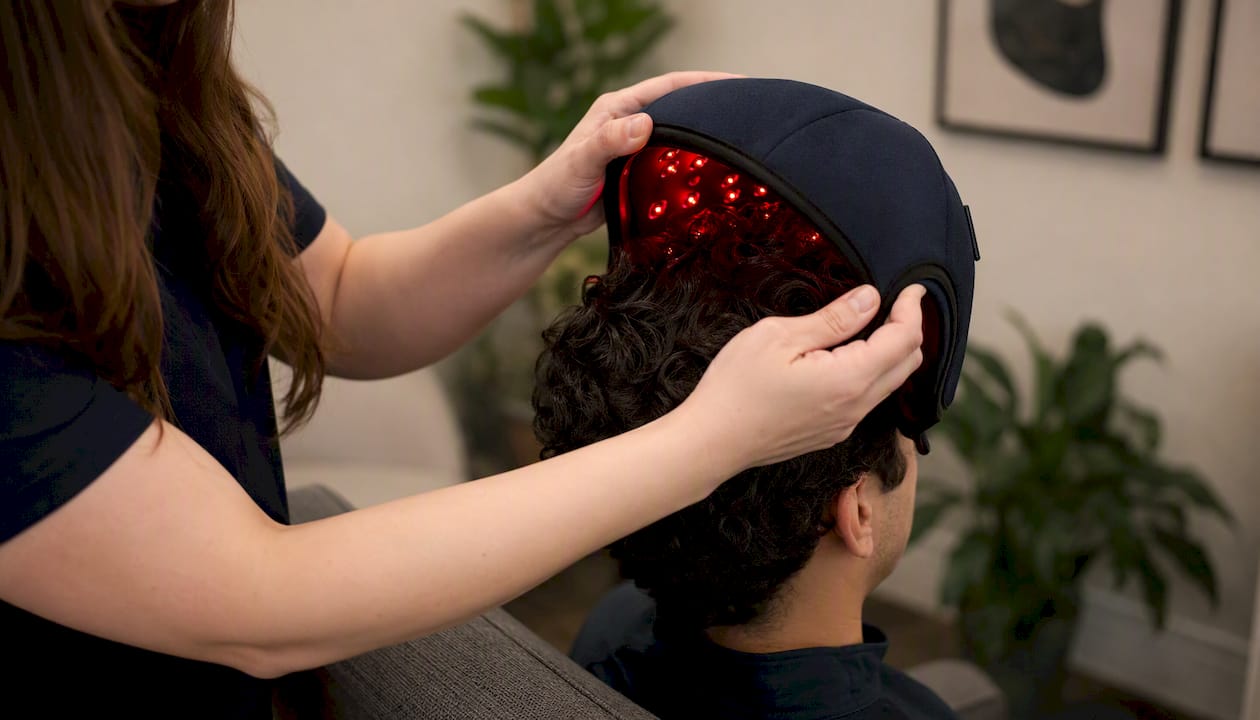
LLLT uses low-power laser diodes, most commonly at 650nm, to deliver photobiomodulation to the scalp. The light penetrates the skin and stimulates mitochondrial activity in hair follicle cells, encouraging the follicle to shift from a resting phase back into active growth. Devices range from clinic-grade helmets to at-home laser caps. LLLT is the most established light-based device with a clearer evidence base than other energy-based approaches.
Cold plasma therapy
Cold plasma targets the follicle microenvironment using ionised gas at near-room temperature. Early clinical reports describe it as a promising way to reduce scalp inflammation and potentially reactivate dormant follicles, but the method remains largely investigational and is not yet a standard clinic offering in the UK.
Platelet-rich plasma (PRP)
PRP involves drawing a small amount of your blood, concentrating the growth-factor-rich plasma, and injecting it into thinning areas of the scalp. It is a clinic-only procedure. Evidence from cohort studies and small trials shows measurable improvement in hair density for some patients, though outcomes vary considerably with protocol and practitioner skill.
Microneedling and scalp needling
A dermaroller or motorised pen creates micro-injuries across the scalp, triggering a wound-healing response that can stimulate follicle activity and improve topical absorption. It can be performed in a clinic or, with a lower-gauge roller, at home. Combining microneedling with a topical serum tends to produce better results than either alone.
Topical botanical shampoos and serums
Caffeine, rosemary oil, saw palmetto, and biotin are the most clinically studied botanical actives for hair thinning. Caffeine penetrates the follicle and counters the suppressive effect of DHT on hair growth. Rosemary oil improves scalp circulation and has shown comparable results to low-concentration minoxidil in some trials. Saw palmetto acts as a mild topical 5α-reductase inhibitor, reducing DHT sensitivity without systemic hormonal effects. Biotin supports keratin production and can be used effectively through products like the Onion & Biotin Shampoo Bar | Zenith. These actives are delivered through shampoos, conditioners, serums, and oils for daily use at home.
Oral nutritional supplements
Biotin (vitamin B7), zinc, iron, vitamin D, and targeted hair-support blends address nutritional gaps that can accelerate shedding. Biotin gummies are among the most popular formats in the UK. Supplements work best as part of a broader regimen rather than as a standalone fix, particularly where a deficiency has been confirmed.
Scalp massage and stimulation
Regular scalp massage, whether manual or with a silicone brush, increases blood flow to follicles and may reduce tension-related restriction. Studies suggest consistent daily massage over several months can contribute to modest improvements in hair thickness, particularly when combined with topical application.
Cosmetic camouflage
Hairpieces, hair fibres, and scalp concealers provide immediate visual coverage without any biological effect on the follicle. They are a practical option for managing appearance while longer-term treatments take effect.
| Treatment type | Clinic or at-home | Primary mechanism |
|---|---|---|
| LLLT laser cap | At-home | Photobiomodulation, mitochondrial stimulation |
| Cold plasma | Clinic (experimental) | Follicle microenvironment modulation |
| PRP | Clinic only | Growth-factor delivery via injection |
| Microneedling | Clinic or at-home | Wound-healing response, improved topical absorption |
| Botanical shampoos/serums | At-home | Circulation, DHT inhibition, keratin support |
| Oral supplements | At-home | Nutritional support for follicle function |
| Scalp massage | At-home | Blood flow stimulation |
| Cosmetic camouflage | At-home | Visual coverage |
What does the science actually say about each option?
Evidence for drug-free treatments falls into three broad tiers. Strong evidence comes from randomised controlled trials (RCTs) with meaningful sample sizes. Moderate evidence draws on cohort studies, case series, or smaller RCTs. Limited evidence reflects preclinical data, single case reports, or early-stage trials only.
Understanding these tiers helps you weigh your choices rather than treat every option as equally proven.
- LLLT (strong to moderate): Multiple RCTs and device-level reviews support 650nm LLLT for androgenetic alopecia. Visible change typically begins around three months of consistent use, with continued improvement through six months and beyond. The JCAS comprehensive review identifies LLLT as the most established light-based device in trichology.
- Rosemary oil (moderate): A comparative trial found rosemary oil produced comparable improvement to 2% minoxidil at six months, with fewer local side effects such as scalp irritation. Small RCTs exist, though larger trials are still limited.
- Caffeine topicals (moderate): In vitro and small human studies show caffeine penetrates the follicle and counters DHT-related suppression. Clinical data are encouraging but not yet at the scale of pharmaceutical trials.
- Saw palmetto (moderate): Meta-analyses of saw palmetto supplements show reductions in hair shedding across several small studies. A 24-week pumpkin seed oil trial (a related 5α-reductase inhibitor) reported approximately a 30% increase in hair count in the study cohort, suggesting meaningful potential for DHT-targeting botanicals.
- Biotin (limited to moderate): Biotin supplementation supports hair structure in people with confirmed deficiency. Evidence for benefit in those with normal biotin levels is less robust.
- PRP (moderate): Clinic-based studies show measurable density improvements, but protocol variability makes direct comparison difficult. Results depend heavily on concentration method and injection technique.
- Microneedling (moderate): Studies support its use as an adjunct, particularly when combined with topical actives. Standalone evidence is thinner.
- Cold plasma, oxygen therapy, ultrasound (limited): These are emerging approaches under active study. Current data are promising but early-stage; none are yet standard care.
Key figure: Consistency over 3–6 months is the primary determinant of success across drug-free regimens. Early abandonment is a common reason treatments appear to fail.
There is also a clear clinical trend towards multi-modal regimens that address circulation, inflammation, and DHT sensitivity simultaneously, rather than relying on a single target. This mirrors the multi-pathway action of pharmaceuticals, without the systemic exposure.
Which treatments suit your hair-loss type, and what should you expect?
Not all hair loss responds to the same approach. The three most common patterns each have different drivers, and matching your treatment to your type makes a real difference to outcomes.
Androgenetic alopecia (AGA) is the most prevalent form, driven by DHT sensitivity in genetically predisposed follicles. It presents as a receding hairline or crown thinning in men, and diffuse thinning at the parting in women. LLLT, topical DHT-targeting botanicals (rosemary, saw palmetto), and oral supplements are all well-suited here. For more detail on the female hormonal pattern, this overview of hormonal hair loss in women is worth reading.
Telogen effluvium is a temporary, diffuse shedding triggered by stress, illness, nutritional deficiency, or hormonal shifts. Nutritional support (biotin, iron, vitamin D), scalp massage, and gentle topical serums are the priority. LLLT can support recovery, but addressing the root trigger is the first step.
Alopecia areata is an autoimmune condition causing patchy loss. Drug-free options have limited evidence here; PRP and microneedling show some signals in case series, but this pattern generally warrants specialist input.
- LLLT + topical botanicals: Best suited to early-to-moderate AGA in men and women; also supportive during telogen effluvium recovery.
- PRP and microneedling: Clinic-managed cases of AGA and some telogen effluvium; less evidence for alopecia areata.
- Oral supplements: Supportive across all types, especially where deficiency is confirmed.
- Cold plasma: Experimental; no established suitability mapping yet.
- Cosmetic camouflage: Suitable for any type as an immediate, non-biological option.
| Treatment | Months to initial change | Typical duration | Maintenance |
|---|---|---|---|
| LLLT laser cap | 3 months | 3–6 months | Ongoing sessions |
| Topical botanicals | 2–4 months | Ongoing | Daily use |
| Oral supplements | 2–3 months | Ongoing | Daily use |
| PRP | 3–6 months | 3–6 sessions | Every 3–6 months |
| Microneedling | 3–4 months | 6 sessions | Monthly maintenance |
Realistic improvement means thicker, stronger existing hair and reduced shedding, not necessarily a full restoration of density. For most people with early-stage AGA, a well-maintained regimen produces visible, measurable change. Full regrowth of long-dormant follicles is rarely achievable with any non-surgical approach.
Are these treatments safe, and how are they regulated in the UK?
Most drug-free options carry a lower systemic risk profile than pharmaceutical treatments, but that does not mean they are risk-free. Safety varies significantly by method, device quality, and practitioner skill.
Common side effects by method:
- LLLT: Mild scalp warmth or temporary increased shedding in the first few weeks (a normal follicle-cycling response). Rare with properly specified devices.
- PRP: Local soreness, bruising, and a small infection risk at injection sites. Clinic hygiene and practitioner credentials matter greatly.
- Microneedling: Redness, sensitivity, and infection risk if aftercare is poor or equipment is not sterile.
- Topical botanicals: Occasional contact irritation, particularly with concentrated essential oils. Patch testing is advisable.
- Oral supplements: Generally well tolerated at recommended doses; excess biotin can interfere with certain blood tests.
UK regulation and availability checklist:
- For at-home LLLT devices, look for UKCA or CE marking confirming the device meets medical or electrical safety standards.
- Clinic-based procedures (PRP, microneedling) should be performed by a qualified trichologist or dermatologist. The MHRA regulates medical devices sold in the UK; check that any device you purchase is listed or compliant.
- Ask clinics for their practitioner credentials, sterilisation protocols, and evidence of before-and-after case series before committing.
- Only two medications (minoxidil and finasteride) hold regulatory approval for androgenetic alopecia in major jurisdictions; device and botanical products operate under different regulatory categories and should be assessed on their clinical evidence, not assumed equivalent to pharmaceutical approval.
Pro Tip: When evaluating an at-home LLLT device, ask the seller for the wavelength specification (should be 650nm), diode count, power density data, and warranty terms. A supplier that cannot provide these details is a red flag.
How do you choose the right drug-free treatment for you?
The sheer number of options can make choosing feel complicated. A structured approach cuts through it quickly.
Step-by-step decision checklist:
- Get a diagnosis first. A GP or trichologist can confirm your hair-loss type, rule out underlying conditions, and give you a baseline to measure progress against.
- Assess severity. Mild to moderate early thinning responds well to at-home LLLT and topical regimens. More advanced loss may warrant clinic-based procedures alongside.
- Set a realistic budget. Drug-free treatments range from low-cost supplements to higher-investment devices and clinic sessions.
- Consider your time commitment. Daily topical application and regular LLLT sessions require consistency. If adherence is likely to be a challenge, start with the simplest regimen and build from there.
- Decide on clinic versus at-home. PRP and microneedling require a clinic; LLLT, topicals, and supplements are all manageable at home.
Questions to ask a clinic or device seller:
- What is the wavelength, diode count, and power density of the device?
- What clinical evidence supports this specific product or protocol?
- Can you show before-and-after case series from real patients?
- What is the warranty and returns policy?
- What aftercare or follow-up support is included?
Red flags to avoid:
- No published device specifications or clinical evidence
- Promises of full regrowth in weeks
- No UKCA or CE marking on a device sold as medical-grade
- High-pressure sales tactics or no-refund policies
- “Natural” claims with no ingredient transparency
Rough UK cost ranges:
- At-home LLLT laser cap: typically several hundred pounds as a one-time investment
- PRP session (clinic): roughly £200–£500 per session, with multiple sessions recommended
- Microneedling course (clinic): approximately £100–£300 per session
- Topical botanical shampoo/serum regimen: £20–£60 per month
- Biotin gummies and supplements: £10–£30 per month
- Cosmetic camouflage products: £10–£50 per month
Why a high-quality 650nm LLLT cap is the foundation of most at-home regimens
Medical-grade LLLT at 650nm, with adequate power density, produces mitochondrial stimulation in follicle cells that can increase hair thickness over months when used consistently. This is not a fringe claim; it is supported by a substantial body of device-level and clinical research.
The reason wavelength matters is specificity. At 650nm, laser light sits in the red-light spectrum that follicle mitochondria absorb most efficiently. Devices that use lower-quality LEDs or unspecified wavelengths do not deliver the same photobiomodulation effect, regardless of how they are marketed.
What to verify before buying an LLLT cap:
- Wavelength: Confirmed 650nm laser diodes (not generic red LEDs)
- Diode count: Higher counts provide more even scalp coverage
- Power density: Should be published and within the range used in clinical trials
- UKCA or CE marking: Confirms the device meets UK/European safety standards
- Warranty: A reputable supplier will offer a meaningful guarantee
- Clinical evidence: Published case studies or trial data, not just testimonials
A suggested protocol for at-home LLLT is 20–30 minutes per session, three to five times per week. Most people notice the first signs of change around three months, with more consistent improvement through six months. Maintenance sessions are needed to sustain results, as the follicle response is ongoing rather than permanent.
Livdor’s 650nm laser hair growth cap is built to these specifications, with 272 medical-grade laser diodes and a published wavelength. It is available directly in the UK with a comprehensive warranty, and Livdor has clinic partnerships with trichologists who use the device in supervised protocols. For readers who want to understand how the device fits into a broader treatment plan, Livdor’s how-it-works page sets this out clearly.
Pro Tip: Combining your LLLT sessions with a topical serum containing biotin, caffeine, and Pro-Vitamin B5 applied immediately before or after each session can improve follicle uptake of active ingredients, since microcirculation is temporarily elevated post-treatment.
Clinical outcome data from device trials typically show improvements in hair count and shaft diameter rather than dramatic density restoration. Combined therapy (LLLT plus topical botanicals plus oral supplements) consistently outperforms any single modality used alone, which is why a regimen approach is the standard recommendation across practitioner-level reviews.
Key takeaways
The most effective drug-free approach for early hair thinning combines a clinically specified 650nm LLLT device with daily topical botanicals and consistent oral nutritional support, maintained for at least three to six months.
| Point | Details |
|---|---|
| LLLT is the strongest at-home device option | A 650nm laser cap with verified diode count and power density is the most evidence-backed at-home device for AGA. |
| Combination regimens outperform single treatments | Pairing LLLT with rosemary/saw palmetto topicals and biotin supplements addresses multiple pathways simultaneously. |
| Consistency over 3–6 months determines success | Early abandonment is the most common reason drug-free treatments appear to fail; adherence is the key variable. |
| Diagnosis before treatment | A trichologist or GP assessment confirms hair-loss type and prevents wasted spend on the wrong approach. |
| Livdor’s 650nm cap and regimen products | Livdor offers a clinically specified LLLT cap alongside rosemary shampoos, biotin serums, and supplements as a complete at-home pathway. |
The case for committing to a drug-free regimen
There is a tendency to treat pharmaceutical-free options as a consolation prize: what you try before the “real” treatment. That framing is outdated, and it does readers a disservice.
The clinical picture has shifted. Rosemary oil matching 2% minoxidil at six months in a comparative trial is not a minor footnote; it is a meaningful signal that well-formulated botanicals can hold their own. LLLT has accumulated enough RCT-level evidence to feature in trichologist protocols alongside prescription options. The gap between “natural” and “effective” is narrower than most people assume, provided the products are properly specified and used consistently.
What the evidence does not support is the idea that any single drug-free treatment works in isolation. The people who see the best outcomes are those who treat it as a regimen: a device session three to five times a week, a targeted shampoo and serum daily, and a supplement that fills nutritional gaps. That combination addresses the follicle from multiple angles simultaneously, which is precisely what makes it competitive with pharmaceutical mono-therapy.
The other thing worth saying plainly: patience is not optional. Three months feels like a long time when you are watching your hairline. But the follicle cycle does not accelerate because you want it to. Commit to the protocol, track your progress with photos, and resist the urge to switch products before giving any one approach a fair run.
Livdor’s drug-free hair regimen: a complete at-home pathway
If you have read this far and want a straightforward starting point, Livdor’s range is built around exactly the combination this article recommends: a clinically specified LLLT device, targeted botanical topicals, and premium nutritional support, all drug-free and designed for at-home use.
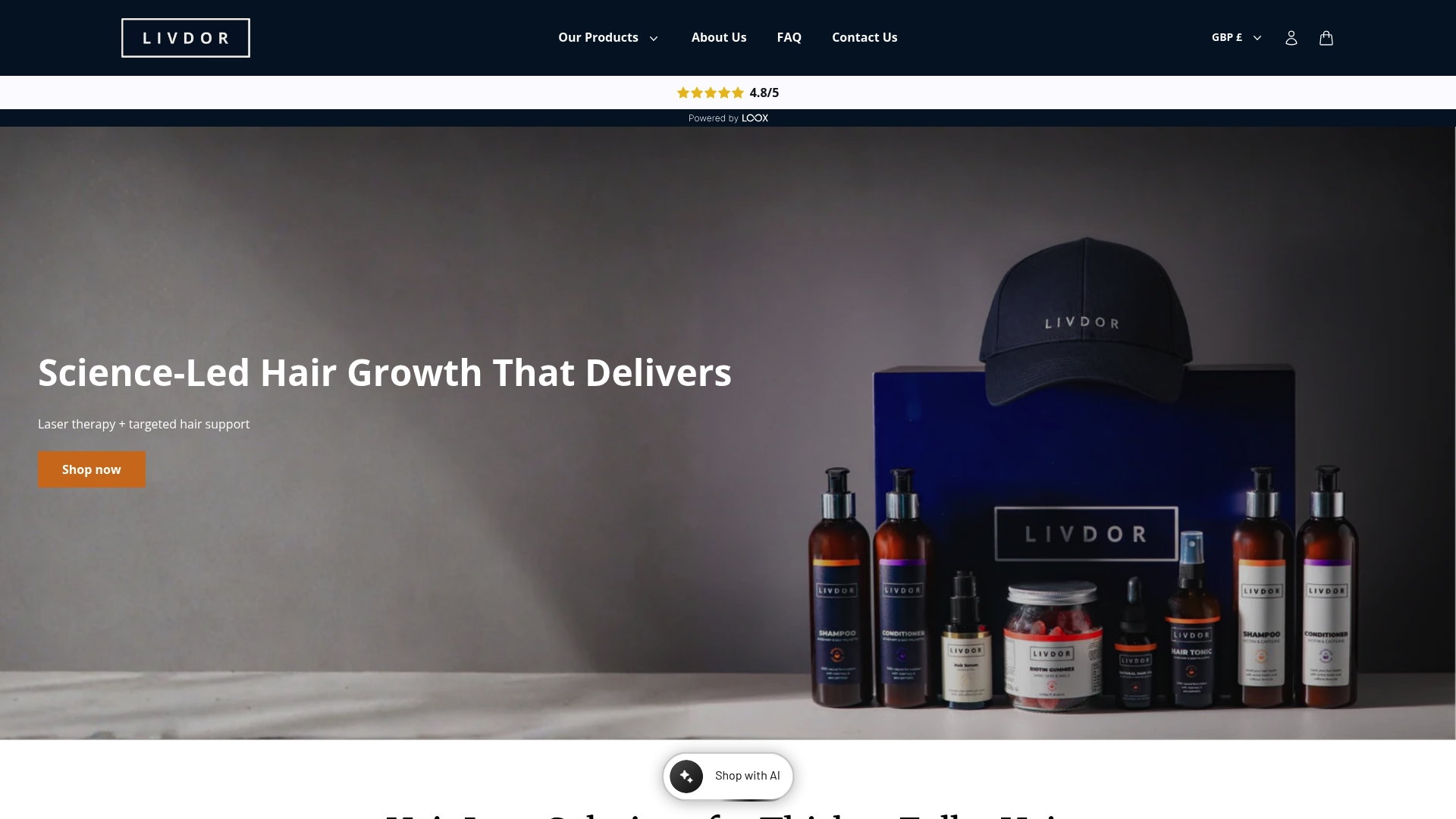
The Livdor laser hair growth cap uses 272 medical-grade 650nm laser diodes and is available in the UK with fast delivery and a comprehensive warranty. Pair it with Livdor’s rosemary and saw palmetto shampoo, the hair growth serum containing biotin, caffeine, and Pro-Vitamin B5, and the biotin gummies for a complete multi-pathway regimen. The rosemary conditioner with saw palmetto rounds out the daily wash routine, keeping the scalp environment supportive between device sessions.
Used together, this combination targets DHT sensitivity, scalp circulation, follicle energy production, and nutritional support in one consistent daily routine. Visible results typically begin after several months. Livdor also partners with UK trichology clinics, including Kirsty Hair and Care Trichology, for those who want supervised support alongside their at-home regimen.
Browse the full range and start your regimen at livdor.com.
Useful sources
The following primary references and clinical reviews underpin the evidence discussed in this article. They are worth bookmarking if you want to read the underlying research before making treatment decisions.
- Technological advances in anti-hair loss and hair regrowth cosmeceuticals (PMC review) — supports evidence tiers for LLLT, botanicals, and combined regimens; relevant to the evidence summary and key takeaways sections.
- Advancements in non-laser energy-based devices in trichology: a comprehensive review (JCAS) — the strongest source for LLLT device specifications, protocol guidance, and non-laser device comparisons; supports the LLLT and device-spec sections.
- Complementary and alternative treatments for alopecia: a comprehensive review (PMC) — broad CAM review covering herbal, nutritional, and mind-body approaches; useful background for suitability mapping by hair-loss type.
- Minoxidil vs natural remedies: hair growth comparison (Beauté Cosmetic) — source for the rosemary vs minoxidil comparative trial data and pumpkin seed oil hair count figures.
- Drug-free hair growth explained: what actually works (Livdor blog) — editorial overview comparing drug-free approaches; useful companion reading alongside this article.
- Non-pharmaceutical hair thinning remedies that work (Livdor blog) — practical round-up of non-drug remedies with clinical rationale.
FAQ
Which drug-free hair treatment has the strongest evidence?
LLLT at 650nm has the strongest evidence base among at-home drug-free options, supported by multiple RCTs and device-level reviews. Rosemary oil also has meaningful trial data, including a comparative study showing results comparable to 2% minoxidil at six months.
What are the main non-pharmaceutical treatments for hair loss?
The main non-pharmaceutical options are LLLT laser caps, topical botanical shampoos and serums (caffeine, rosemary, saw palmetto, biotin), oral supplements, microneedling, PRP, scalp massage, and cosmetic camouflage. Most work best in combination rather than as standalone treatments.
How long do drug-free hair treatments take to show results?
Most drug-free treatments require 3–6 months of consistent use before visible improvement appears. LLLT and topical botanicals typically show initial change around three months, with continued progress through six months and beyond.
Are there chemical-free options that work for androgenetic alopecia?
Yes. LLLT, rosemary and saw palmetto topicals, and DHT-targeting supplements all have clinical signals of benefit for androgenetic alopecia. A combined regimen addressing multiple pathways simultaneously tends to produce the best outcomes for this pattern of hair loss.
What should I look for in a drug-free hair loss device sold in the UK?
Look for a confirmed 650nm wavelength, published diode count and power density, UKCA or CE marking, a meaningful warranty, and verifiable clinical evidence. Livdor’s laser cap meets these specifications and is available with UK delivery and trichology clinic support.

Leave a comment
This site is protected by hCaptcha and the hCaptcha Privacy Policy and Terms of Service apply.